Stop Puppy Biting in 24 Hours: The “Ouch” Method That Actually Works
The arrival of a new puppy brings unparalleled joy, but the relentless needle-sharp bites that accompany it can quickly turn delight into distress. You are not alone in your frustration. This behavior, often called ‘mouthing’ or ‘play biting,’ is one of the most common challenges new puppy owners face. The title’s promise of a ’24-hour’ fix is designed to grab your attention, but let’s be clear from a professional standpoint: lasting behavioral change requires consistency over time. However, a significant breakthrough in your puppy’s understanding can absolutely be achieved in a day by correctly applying the right principles. This guide will move beyond simplistic advice and provide a comprehensive, behaviorist-approved framework for addressing puppy biting. We will delve into the canine psychology driving the behavior, explore the critical concept of bite inhibition, and provide a detailed, step-by-step protocol for the ‘Ouch’ method—a technique that, when executed properly, leverages your puppy’s natural social learning instincts to teach them that human skin is fragile. Prepare to transform your relationship from a painful one into a partnership built on clear communication and mutual respect.
Why Your Puppy Bites: It’s Not Aggression

Before you can correct a behavior, you must understand its origin. It is imperative to recognize that in the vast majority of cases, puppy biting is not a sign of aggression. It is a normal, natural, and necessary part of canine development. Puppies explore the world with their mouths in the same way human toddlers explore with their hands. This oral exploration serves several key purposes.
First and foremost, it is how puppies learn about their own strength. When puppies play with their littermates, they bite and mouth each other constantly. If one puppy bites another too hard, the victim will yelp loudly and momentarily stop playing. This immediate, clear feedback is a powerful lesson: ‘That specific pressure hurts, and it causes the fun to end.’ Through thousands of these micro-interactions, puppies develop what is known as bite inhibition—the ability to control the force of their jaw. When we bring a puppy home, we remove them from their primary teachers, their siblings. The responsibility of teaching this crucial life skill now falls entirely to us.
Second, teething contributes significantly to a puppy’s need to chew. From approximately three to six months of age, puppies lose their deciduous (baby) teeth and their adult teeth emerge. This process can be uncomfortable and even painful. The pressure from chewing on objects, including your hands and ankles, helps to alleviate this discomfort. Your puppy isn’t trying to hurt you; they are trying to soothe their aching gums. It is our job to teach them what is appropriate to chew on and what is off-limits.
The Goal Isn’t Zero Biting (At First)—It’s Bite Inhibition

This is the single most important concept for owners to grasp, and it is where most training attempts fail. The initial objective is not to stop the puppy from putting its mouth on you entirely. The primary goal is to teach them to use their mouth gently. A puppy that is forbidden from ever making mouth contact with human skin never learns how much pressure is too much. This can create a dangerous adult dog. A well-socialized adult dog with excellent bite inhibition might still bite if severely provoked, frightened, or in extreme pain, but they are far more likely to do so with a controlled pressure that does not break the skin. A dog that was never taught this control is more likely to inflict serious damage unintentionally.
Think of it as teaching a child to have ‘gentle hands.’ We don’t forbid them from ever touching; we teach them the appropriate pressure for different interactions. Your first phase of training is to teach your puppy that human skin is exceptionally sensitive. Only after they have learned to mouth you with the softness of a butterfly’s wings do you then progress to teaching them to not mouth at all, redirecting them instead to toys. Rushing this process by trying to eliminate all mouthing from day one is a critical error that bypasses the most important lesson of all.
The ‘Ouch’ Method: A Step-by-Step Implementation Guide

This technique, also known as bite inhibition training, directly mimics the way puppies teach each other. It requires consistency, perfect timing, and the participation of every human in the household. Follow these steps precisely for the best results.
-
Step 1: Initiate Calm Play
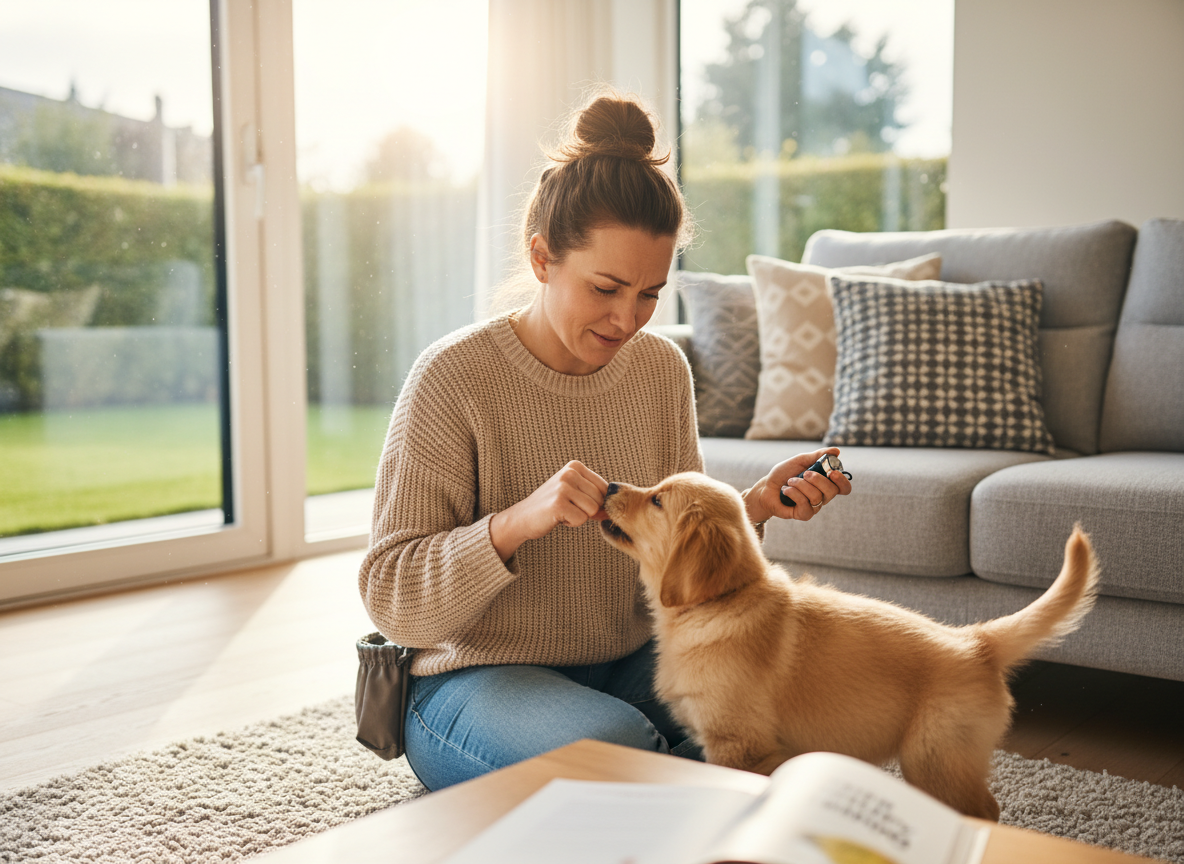
The learning process must be intentional. Do not wait for an ambush attack on your ankles. Sit on the floor with your puppy in a calm, controlled environment. Engage them in gentle play with your hands. Allow them to mouth your fingers and hand. This is the setup for the lesson. You are creating a predictable scenario where you can control the variables and provide clear feedback.
-
Step 2: The ‘Ouch!’ and Immediate Withdrawal
The moment you feel a tooth pressure that is even slightly too hard, you must react instantly. Let out a high-pitched, sharp, and surprising ‘OUCH!’ or ‘YIP!’. It should sound more like a hurt puppy than an angry adult. The goal is to startle, not to scare. Simultaneously, as you yelp, your hand should go completely limp and you should pull it away from the puppy’s mouth. This combination of auditory and physical feedback signals that the game has changed.
-
Step 3: The Social Consequence (The Time-Out)
This is the most critical part of the lesson. The yelp alone is not the teacher; the consequence is. Immediately after withdrawing your hand, stand up, turn your back on the puppy, and cross your arms. Ignore them completely for a brief period—no more than 10 to 30 seconds. This social isolation is a powerful communicator in the canine world. The message you are sending is crystal clear: ‘When you bite too hard, your favorite playmate disappears and all fun stops.’ This is not a punishment in the human sense; it is a direct, logical consequence from the puppy’s perspective.
-
Step 4: Re-engage and Repeat
After the short time-out, turn back to your puppy, ask for a simple behavior you know they can do (like ‘sit’), and then calmly re-engage in the same hand-play. You must give them another chance to get it right. They will likely bite too hard again. Repeat steps 2 and 3. Through this repetition, your puppy will begin to experiment, thinking, ‘Okay, that pressure made the fun stop. What if I try a little softer?’ They will gradually learn to moderate the force of their jaw to keep the game going. You are shaping their behavior with every interaction.
-
Step 5: Redirect to an Appropriate Chew Toy
Once your puppy has demonstrated a consistent ability to mouth your hands gently, you can move to the next phase. Now, when they approach to mouth you, preemptively offer them an appropriate and exciting chew toy. Lavish them with praise when they choose the toy over your hand. This teaches them the final rule: ‘Hands are for gentle play, but toys are for chewing.’ You are not just telling them ‘no’; you are showing them the correct ‘yes’.
Troubleshooting: When the ‘Ouch’ Method Doesn’t Work

While this method is highly effective, individual puppies may respond differently. If you are not seeing progress, consider these common pitfalls and adjustments.
What if ‘Ouch!’ Excites My Puppy More?
For some high-arousal or high-drive puppies (often seen in herding or terrier breeds), a high-pitched yelp can act as a stimulant rather than a deterrent. It can ramp them up and incite more frantic biting. If you observe this reaction, drop the yelp entirely. Instead, use a calm but firm verbal marker like ‘Too Bad’ or ‘Nope.’ The power of the technique is not in the word but in the immediate withdrawal and social time-out that follows. The consequence remains the same: hard biting makes the human leave.
Consistency is Non-Negotiable
This is the number one reason for failure. Every single person in the household, and any guest who interacts with the puppy, must follow the exact same protocol every single time. If one person allows hard biting while another does not, you are sending mixed signals that will hopelessly confuse your puppy. The rules must be absolute. Hold a family meeting and ensure everyone is committed to the plan.
Avoid Physical Punishment at All Costs
Methods such as tapping the puppy on the nose, forcing a finger down their throat, holding their muzzle shut, or performing an ‘alpha roll’ are archaic, dangerous, and counterproductive. These actions do not teach your puppy anything about bite inhibition. Instead, they teach your puppy that hands coming towards their face are a threat. This can erode trust, create fear-based aggression, and make future handling for grooming or veterinary care incredibly difficult. Your relationship with your dog must be built on trust, not intimidation.
Managing Over-Tiredness and Arousal
Puppies, much like human toddlers, have very poor emotional regulation when they are tired. Many owners report a ‘witching hour’ in the evening when their puppy becomes an uncontrollable biting machine. This is almost always a sign of an over-tired puppy. Enforce a regular schedule of naps in a crate or pen throughout the day. A typical young puppy may need 18-20 hours of sleep per day. If biting suddenly escalates, it’s likely time for a nap, not more training.
Setting Your Puppy Up for Success: Management and Tools

Effective training is not just about reacting to bad behavior; it’s about proactively managing the environment to encourage good behavior. Use these tools and techniques to support your bite inhibition training.
- A Puppy-Proofed Environment: Limit your puppy’s access to areas of the house until they have learned the rules. Use baby gates and playpens to create a safe, manageable space where they cannot get into trouble by chewing on furniture or electrical cords.
- A Diverse Arsenal of Chew Toys: A puppy needs a wide variety of legal chew outlets. Do not just provide one or two toys. Offer different materials and textures to keep them engaged. Good options include hard nylon toys, durable rubber toys that can be stuffed with food (like Kongs), puzzle toys, and even softer plush toys for supervised, gentle mouthing. Rotate the toys to maintain novelty and interest.
- Appropriate Exercise: A tired puppy is a well-behaved puppy. Ensure your puppy gets adequate physical exercise and mental stimulation each day. This includes short walks (respecting their growing joints), training sessions, and puzzle feeders. However, be cautious of over-exercising, which can lead to exhaustion and the frantic biting you’re trying to avoid.
- Crate Training: The crate is not a place of punishment. It is a vital management tool that serves as your puppy’s safe den. It is indispensable for enforcing scheduled naps, preventing destructive chewing when you cannot supervise them, and helping with housetraining.
Recognizing Red Flags: When to Consult a Professional

While play biting is normal, it’s crucial to distinguish it from true aggression, which is rare in young puppies but requires immediate professional intervention. Contact a certified professional dog trainer (CPDT-KA) or a board-certified veterinary behaviorist (DACVB) if you observe the following:
- Body Language: The biting is accompanied by a stiff, frozen body posture, a hard stare, or pinned-back ears. A playful puppy is loose and wiggly; an aggressive dog is tense.
- Vocalization: The mouthing is paired with deep, guttural growling or snarling, not playful yips or growls.
- Intent: The bites seem targeted and intentional rather than incidental during play. The puppy may charge from across the room to bite, or guard resources like food or toys.
- Injury: The bites are consistently breaking the skin and seem to lack any sense of pressure modulation, even after weeks of consistent training.
Never hesitate to seek professional guidance. Addressing potential aggression early is the key to a safe and successful outcome for both you and your dog.
Conclusion
The journey of teaching your puppy bite inhibition is a testament to your commitment as a responsible pet owner. It is a process that requires patience, absolute consistency, and an understanding of your puppy’s developmental needs. The ‘Ouch’ method is not a magic wand, but a powerful communication tool that bridges the gap between human and canine understanding. By becoming your puppy’s teacher, you are not just stopping a painful behavior; you are building a foundational language of trust and respect. You are teaching them how to live safely and gently in a human world. Embrace the process, manage the environment proactively, and celebrate the small victories. The result will be a well-adjusted, trustworthy canine companion with a soft mouth and a deep bond with the person who so patiently guided them.