Help! My Dog Won’t Let My Spouse In Bed: Breaking the Resource Guarding Cycle

The scenario is deeply familiar and profoundly frustrating for many couples. One partner is comfortably in bed, but when the other approaches, the family dog—positioned squarely on the mattress—emits a low growl. The air thickens with tension. This isn’t just a minor annoyance; it’s a behavior that can strain relationships and create a feeling of being an outsider in one’s own home. Many owners misinterpret this as protectiveness or jealousy, but from a clinical perspective, this is a classic case of resource guarding.
The dog is not acting out of spite or a complex emotional vendetta against your spouse. It is acting on a deep-seated canine instinct to control a high-value resource. In this case, the resource could be the bed itself, the prime space next to you, or even you. This guide will provide a clear, authoritative, and safe framework for addressing this issue. We will dismantle the behavior, understand its roots, and implement a professional-grade behavior modification plan to restore peace to your bedroom and your relationship. Safety is paramount, and the first step is always to manage the situation to prevent escalation.
Understanding Canine Resource Guarding: Why Your Bed Became a Fortress

Understanding Canine Resource Guarding: Why Your Bed Became a Fortress
Before any effective training can begin, you must fundamentally shift your understanding of the problem. Resource guarding, also known as possessive aggression, is a behavior in which a dog uses threats or aggression to maintain control of a valued item or space. This is not a ‘dominance’ play for control of the household; it is typically rooted in anxiety and the fear of losing something valuable. For a dog, resources can range from the obvious (food, toys) to the more abstract (a favorite person, a comfortable resting spot).
The bed is a particularly potent resource. It’s elevated, comfortable, and it smells strongly of the dog’s most valued people. When a dog guards the bed, it is communicating, albeit inappropriately, that it feels insecure about the potential loss of this prime location. The approaching spouse is perceived not as a beloved family member, but as a direct competitor for that resource.
The Ladder of Aggression
Guarding behavior rarely begins with a snap or a bite. It begins with subtle signals that owners often miss. Understanding this ‘ladder of aggression’ is critical for recognizing your dog’s discomfort long before it escalates.
- Subtle Signs: The earliest warnings include body stiffening, a hard stare, closed mouth, and ‘whale eye’ (when the whites of the eyes are visible). The dog might simply block access with its body.
- Audible Warnings: If the subtle signs are ignored, the dog may escalate to a low rumble or a full-throated growl. A growl is not a threat to be punished; it is a critical piece of communication that says, “I am uncomfortable, please stop.” Punishing a growl is like removing the batteries from a smoke detector—it eliminates the warning, but not the danger.
- Overt Aggression: The final rungs of the ladder include snarling (lifting the lip to show teeth), snapping, and biting. By the time a dog reaches this stage, it feels its previous warnings have been ignored and it must resort to more drastic measures to protect its resource.
Your goal is to learn to see the subtle signs and de-escalate the situation, rather than forcing a confrontation that pushes your dog further up the ladder.
Phase One: Immediate Safety and Management Protocols
Phase One: Immediate Safety and Management Protocols
Before you can modify a behavior, you must first manage the environment to ensure everyone’s safety and to stop the dog from rehearsing the unwanted behavior. Management is not training, but it is the non-negotiable first step. Every time your dog successfully guards the bed, the behavior is reinforced, making it more likely to happen again.
The Bed is Now a No-Dog Zone
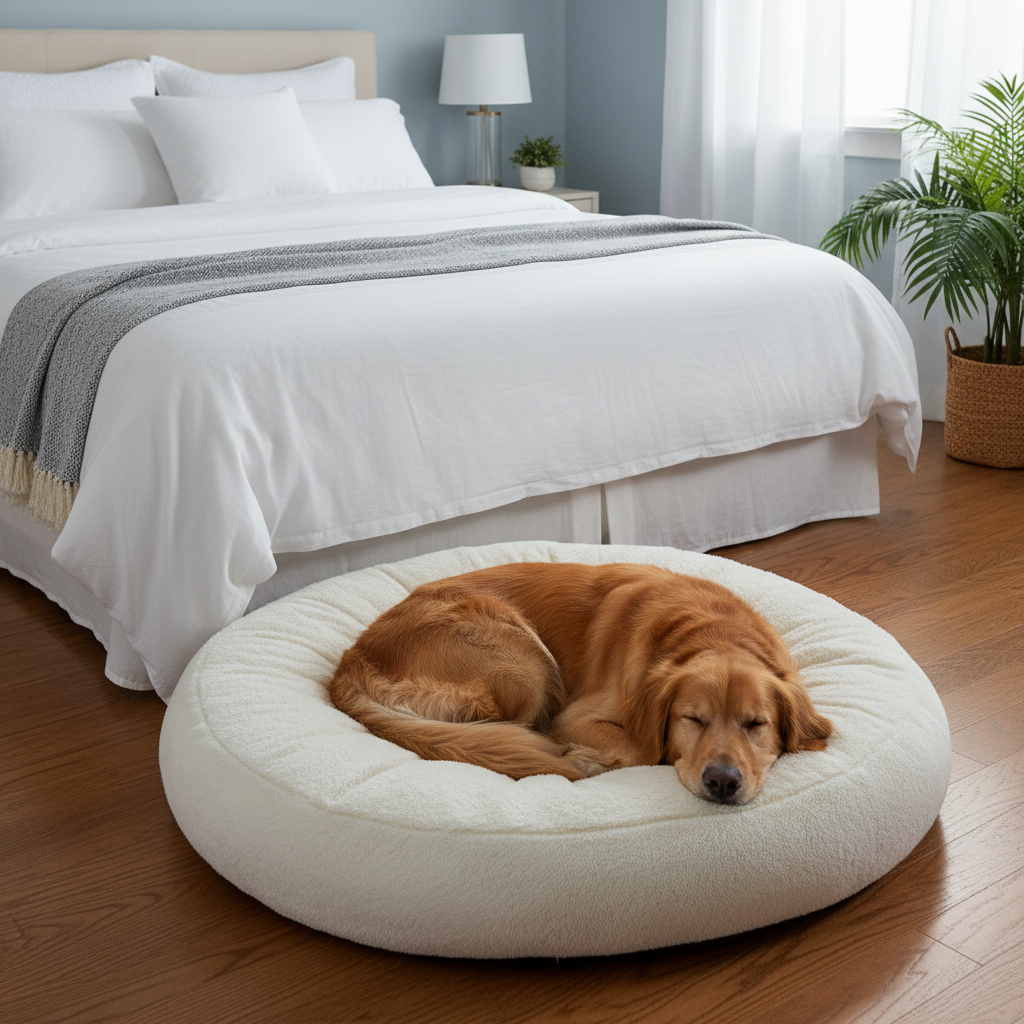
Effective immediately, the bed is off-limits to the dog. This is not a punishment, but a simple management strategy. By removing the resource, you remove the opportunity for guarding to occur. This instantly lowers the stress level for everyone involved—you, your spouse, and the dog—and prevents a potential bite.
- Provide a Superior Alternative: Make the floor a fantastic place to be. Invest in a high-quality, comfortable orthopedic dog bed and place it near your bed. Make this new spot highly desirable by leaving special treats or a favorite chew toy there.
- Be Consistent: This rule must be absolute. There can be no ‘just this once’ exceptions. Both partners must be completely aligned and enforce the new boundary consistently. If the dog jumps on the bed, use a cheerful cue like “Off” and lure it down with a treat, then reward it for settling on its own bed.
Never Punish the Growl
It is essential to reiterate this point. If your dog growls, it is giving you a gift of information. It is telling you it is past its comfort threshold. Do not yell at, physically correct, or intimidate the dog for growling. This will only confirm the dog’s belief that the approaching person is a source of conflict and stress. It can also lead to a dog that stops growling and bites without warning. The correct response to a growl is to calmly increase distance and reassess the situation, recognizing that you pushed the dog too far.
Phase Two: The Behavior Modification Blueprint
Phase Two: The Behavior Modification Blueprint
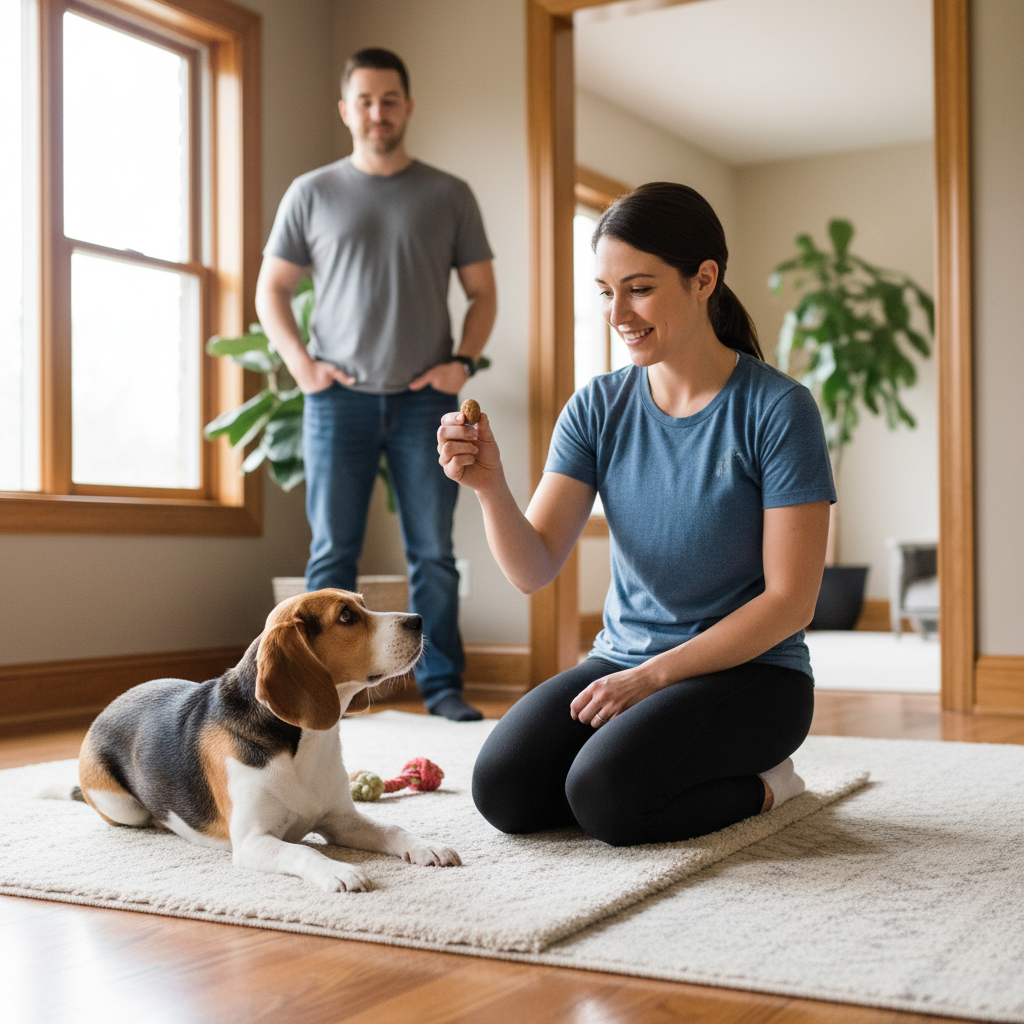
With safety measures in place, we can begin the systematic process of changing your dog’s emotional response. Our goal is to use two powerful, science-based techniques: Desensitization (gradually exposing the dog to the trigger at a level that doesn’t provoke a reaction) and Counter-Conditioning (changing the dog’s association with the trigger from negative to positive). In short, your spouse will become the predictor of truly wonderful things, especially in the context of the bedroom.
Prerequisites: Assembling Your Toolkit
Before you begin, gather your supplies. Success depends on being prepared.
- High-Value Treats: This is not the time for dry kibble. You need culinary rewards that your dog finds irresistible. Think small pieces of cooked chicken, cheese, hot dogs, or commercial freeze-dried liver.
- A Designated Station: The dog’s new bed on the floor will serve as its ‘station’ for these exercises.
- Patience and Teamwork: Both partners must be involved and committed to the process. Progress will be measured in small increments, not giant leaps.
The Step-by-Step Protocol
This plan must be followed sequentially. Do not skip steps. If at any point the dog shows signs of stress, you have moved too quickly. Go back to the previous step where the dog was successful and work there for a few more sessions.
- Implement a ‘Nothing In Life Is Free’ (NILIF) Program: This foundational step helps create structure and reinforces the concept that you and your spouse are the benevolent leaders who provide all good things. Before your dog gets anything it wants—meals, toys, petting, walks—ask for a simple, known behavior like ‘sit’. Both partners must participate, so the dog learns that polite behavior works with everyone.
- Spouse as the Bringer of All Good Things: Outside of the bedroom, your spouse should take over all the best duties for a week or two. This includes feeding all meals and randomly dropping high-value treats on the floor as they walk by the dog. They should not demand interaction; they are simply a walking treat dispenser. This starts to build a powerful positive association.
- Counter-Conditioning at a Distance: Have the dog relax on its bed in the bedroom. The ‘guarding’ partner should be sitting on the floor or a chair nearby, able to reward the dog for calm behavior. The other spouse (the ‘trigger’) starts the exercise by walking past the open bedroom door at a distance where the dog notices but does not react. The moment the dog sees the spouse, the partner in the room gives the dog a high-value treat. The spouse outside then disappears from view, and the treats stop. Repeat this 5-10 times per session.
- Gradually Decrease the Distance: Over many sessions, the spouse begins to decrease the distance. They walk closer to the doorway. Then, they pause at the doorway. Then, they take one step into the room. Each appearance is marked by the other partner feeding the dog amazing treats. The key is to always work ‘sub-threshold’—at a level where the dog remains calm and comfortable.
- The Spouse Approaches the Bed: Once the spouse can enter the room without any tension from the dog, they can begin approaching the human bed. They walk toward the bed, and the partner gives the dog a treat. They walk away, and the treats stop. Then, they touch the bed for one second, and the dog gets a treat. They sit on the edge of the bed for two seconds, and the dog gets a jackpot of treats. The goal is to make the spouse’s interaction with the bed predict wonderful things for the dog on its own mat.
- Both Partners on the Bed: The final step in this phase involves both partners getting into bed while the dog remains on its floor bed. Initially, just sit on the bed together. Casually toss treats to the dog on its bed. The dog learns that both of you being on the bed together is a very rewarding situation for it.
Phase Three: Re-evaluating the ‘Dog in the Bed’ Privilege

Phase Three: Re-evaluating the ‘Dog in the Bed’ Privilege
After successfully completing the behavior modification plan, your dog should be calm and relaxed when both you and your spouse are in the bedroom and on the bed. For many families, this is the new, harmonious normal. The dog has its own comfortable space, and the humans have theirs. It is critical to ask yourselves: Is it truly necessary for the dog to be back on the bed? For many dogs with a history of resource guarding, the clearest and kindest long-term solution is to maintain the bed as a human-only space. This prevents any future ambiguity or relapse into old behaviors.
However, if you are committed to reintroducing the dog to the bed, it must be done under a new and extremely strict set of rules. This is no longer a right, but a revocable privilege earned through calm behavior.
| Rule | Description | Enforcement |
|---|---|---|
| Invitation Only | The dog is never allowed to jump onto the bed of its own volition. It must be explicitly invited up, using a clear verbal cue like “Up” or “Cuddles.” | If the dog jumps up uninvited, it is immediately asked to get “Off.” Use a happy tone and lure with a treat if necessary. The invitation is then withheld for a period of time. |
| The “Off” Command is Non-Negotiable | The dog must have a 100% reliable “Off” command. When told to get off the bed, it must do so immediately and without protest. Practice this frequently during the day in fun, low-stakes scenarios. | Reward heavily for a quick and cheerful response to the “Off” command. This ensures the cue remains a positive instruction, not a punishment. |
| Zero Tolerance for Guarding Behavior | At the very first, most subtle sign of guarding—a stiff body, a hard stare, a lip curl—the bed privilege is immediately and calmly revoked for the night. Use the “Off” command. | This is not a punishment. It is a clear consequence that teaches the dog that guarding behavior results in the loss of the resource it wants to keep. Consistency is crucial. |
Recognizing When Professional Intervention is Non-Negotiable
Recognizing When Professional Intervention is Non-Negotiable
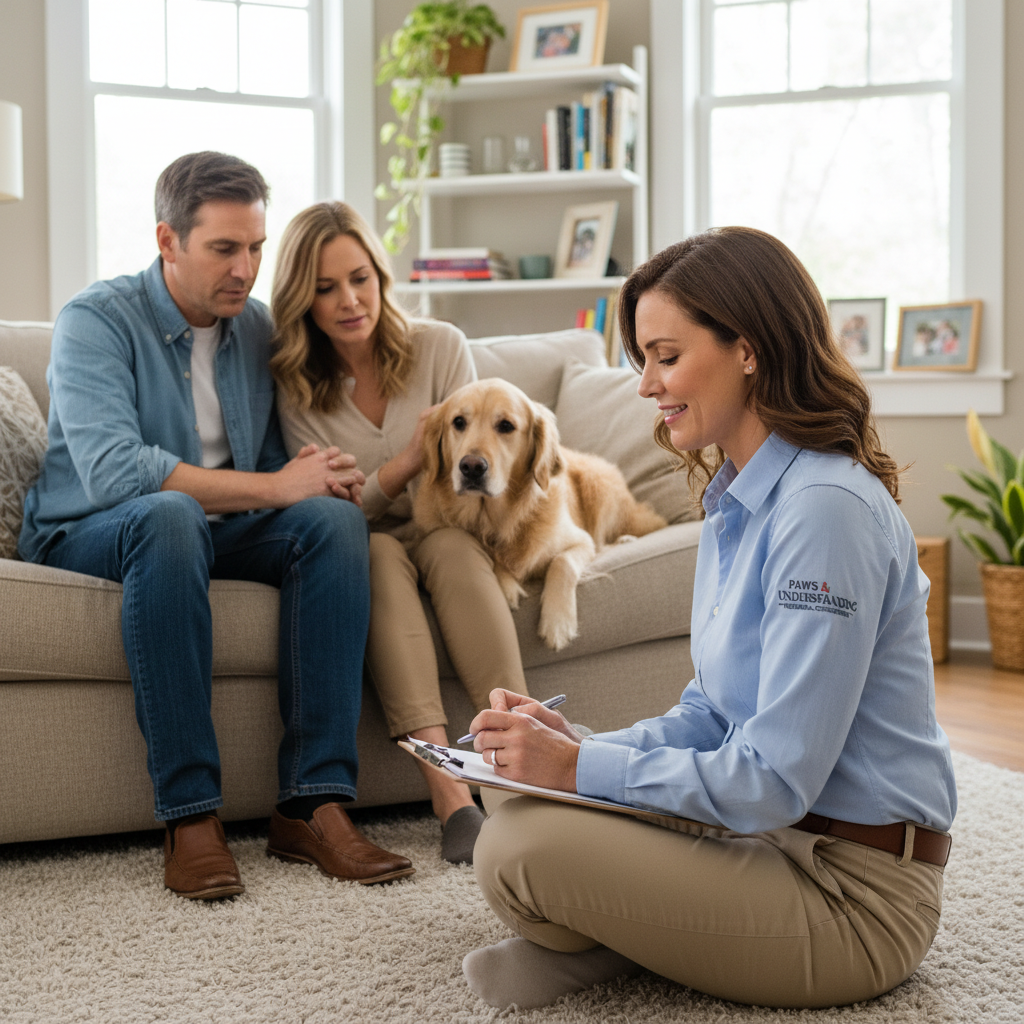
The plan outlined in this guide is effective for moderate cases of resource guarding and for dedicated owners. However, aggression is a serious issue with significant safety implications. There are clear situations where a do-it-yourself approach is insufficient and potentially dangerous. You must seek professional help if you observe any of the following:
- A Bite Has Occurred: If the dog has ever bitten and broken skin, regardless of the severity, you are past the point of DIY training. The liability and risk are too high.
- Rapid Escalation: If the dog moves very quickly up the ladder of aggression (e.g., going from a stare directly to a snap with no growl in between), it indicates a low bite threshold and high volatility.
- Guarding is Generalizing: If the behavior is spreading from the bed to other items like the sofa, toys, or even just the space around one owner, it indicates a more pervasive anxiety issue that requires a comprehensive professional assessment.
- Lack of Progress: If you have diligently implemented the management and training plan for several weeks with no noticeable improvement, or if the behavior is worsening, it is time to bring in an expert.
Finding a Qualified Professional
The field of dog training is unregulated, so it’s vital to choose a professional with the right credentials and a commitment to humane, science-based methods. Look for certified individuals such as a Veterinary Behaviorist (DACVB), a Certified Applied Animal Behaviorist (CAAB), or a Certified Professional Dog Trainer (e.g., CPDT-KA, KSA) who has specific, verifiable experience with aggression and resource guarding cases. Avoid any trainer who advocates using punishment, intimidation, or physical force (e.g., ‘alpha rolls,’ shock collars) to solve the problem, as these methods are likely to make the aggression worse.
Conclusion
Resolving resource guarding in the bedroom is a process that demands patience, consistency, and above all, teamwork between you and your partner. This is not a ‘dog problem’ but a ‘family problem’ that requires a unified solution. By understanding that the behavior stems from insecurity, not malice, you can approach it with empathy and a clear strategy. The immediate implementation of management by making the bed a no-dog zone is your first and most critical step to ensure safety and prevent the behavior from becoming more ingrained.
From there, the systematic process of counter-conditioning and desensitization works to change your dog’s entire emotional perception of your spouse’s presence in the bedroom. Your spouse will transform from a perceived threat into a predictor of wonderful things. Remember that success lies in celebrating small victories and never pushing your dog past its comfort threshold. By replacing conflict with clear communication, consistent boundaries, and positive reinforcement, you can not only solve this specific issue but also deepen the bond of trust with your canine companion. You have the ability to reclaim your bed and restore peace and intimacy to your home.