
Why Dogs Howl at Sirens: Is It Pain or Ancient Instinct?

The sound is unmistakable and almost primal: a distant emergency siren begins to wail, and soon, a canine chorus joins in. For many pet owners, this behavior is a familiar, if perplexing, part of life with a dog. It prompts an immediate question: Why do they do this? A common concern is that the high-pitched sound is causing our beloved companions pain. Others wonder if it’s a remnant of their ancient wolf ancestry, a call of the wild echoing in a modern world. This article provides a comprehensive examination of why dogs howl at sirens, separating myth from scientific fact. We will delve into the leading theories, from the acoustic properties of sirens that trigger this instinctual response to the complex ways dogs communicate with their pack—which includes you. By understanding the root of this behavior, owners can gain a deeper appreciation for their dog’s intricate inner world and learn to distinguish a harmless instinct from a genuine cry for help.
The Call of the Wild: Ancestral Instincts and Pack Communication

To understand why a domesticated dog on a comfortable sofa might suddenly howl at a siren, we must first look back thousands of years to its ancestor: the wolf. For wolves, howling is a cornerstone of social life and survival. It is not random noise; it is a sophisticated form of long-distance communication. A howl can serve several critical functions within a pack:
- Assembly and Location: Howls act as an auditory beacon, helping pack members find each other across vast territories, especially after a hunt or a period of separation. The unique pitch and duration of each wolf’s howl can even help identify individuals.
- Territorial Defense: A chorus of howls serves as a powerful declaration of presence, warning rival packs to keep their distance and avoid conflict. It’s a way of saying, “This territory is occupied.”
- Social Bonding: Group howling, often initiated by the alpha pair, reinforces pack cohesion and social bonds. It is a communal activity that strengthens the unity of the group.
Domestic dogs have inherited this deeply ingrained behavioral software. Although their daily lives no longer require them to rally a pack for a hunt, the instinct remains. The high-pitched, sustained tone of a siren shares remarkable acoustic similarities with a howl. When a dog hears a siren, it may not be interpreting it as a siren at all. Instead, their brain may process it as a potential howl from a distant, unknown dog. Their responsive howl is, in essence, an answer. They could be saying, “I am here, I hear you,” or trying to alert their own pack (their human family) to the presence of another “pack” in the area. This is not a conscious decision but a reflexive, instinctual reaction to a specific auditory trigger that mimics a fundamental piece of their ancestral communication toolkit.
The Science of Sound: Acoustic Triggers and Pitch Perception
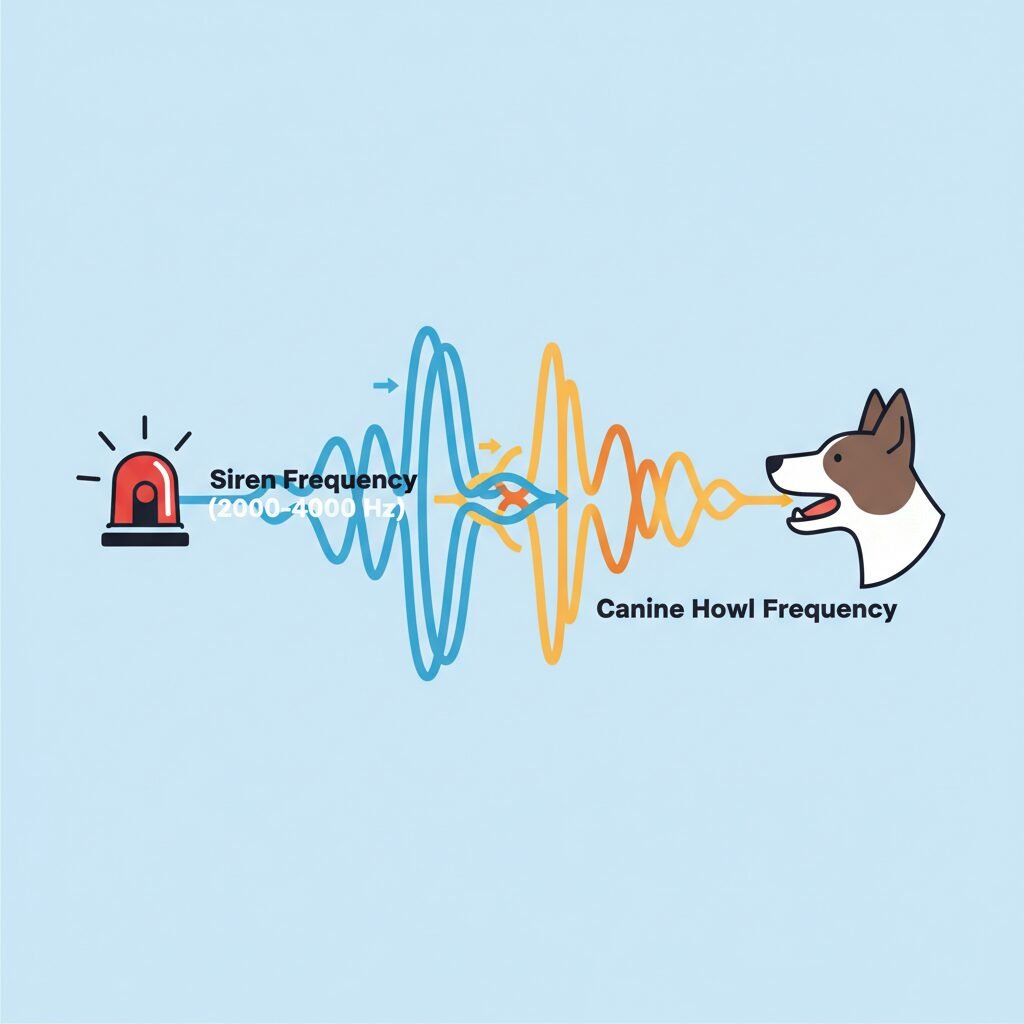
While ancestral instinct provides the “why,” acoustics provides the “how.” The specific characteristics of a siren’s sound are almost perfectly designed to trigger a canine howl. Canine hearing is significantly different from human hearing, particularly in its sensitivity to frequency. Dogs can hear a much wider range of frequencies, reaching up to 45,000-65,000 Hz, compared to the human range of about 20,000 Hz.
Sirens produce sound that is:
- High-Pitched: The frequencies produced by most emergency sirens fall squarely within a dog’s optimal hearing range, making them impossible to ignore.
- Long and Sustained: Unlike a short, sharp bark, a siren’s wail is a continuous, undulating tone. This long duration is a key characteristic of a howl, which is meant to carry over long distances.
- Frequency-Modulated: The classic “nee-naw” of a siren involves a sliding of pitch up and down. This variation may be particularly stimulating to a dog’s ear, making it more compelling than a monotone sound.
When a dog hears these specific acoustic properties, it can trigger an involuntary reflex. It’s a phenomenon known as audiogenic seizure reflex in its most extreme form, but for most dogs, it’s simply a non-painful, automatic response to a compelling sound. It’s similar to how certain musical notes, particularly from instruments like the flute, clarinet, or even a human singing in a high register, can elicit the same howling behavior. The dog is not necessarily enjoying or disliking the sound in an emotional sense; rather, the sound’s specific frequency and duration are hitting a neurological tripwire that says, “This sound is important. Respond.” This explains why some dogs sleep through thunderstorms but bolt upright to howl at a siren two miles away—it’s the specific character of the sound, not its volume, that matters.
Is My Dog in Pain? Debunking a Common and Concerning Myth

One of the most persistent fears among pet owners is that a siren’s high frequency is physically painful to their dog’s sensitive ears. This is a logical concern, but in the vast majority of cases, it is unfounded. A dog’s howl in response to a siren is not a vocalization of pain.
Consider the dog’s body language. A dog howling at a siren typically appears alert and engaged, not distressed. They may stand, tilt their head, and point their ears toward the sound. Their tail might be neutral or even slightly wagging. This posture is one of curiosity and communication, not suffering. In contrast, a dog experiencing auditory pain would exhibit clear signs of distress. These signs are distinctly different from the confident stance of a howling dog.
Signs of Actual Ear Pain or Auditory Discomfort:
- Whining or Yimpering: These are low, pathetic sounds, very different from a full-throated howl.
- Hiding or Attempting to Escape: A dog in pain will try to get away from the source of the sound, seeking refuge under furniture or in another room.
- Pawing at the Ears or Head Shaking: This indicates irritation or pain located directly in the ear.
- Lowered Body Posture: Cowering, tucking the tail, and flattening the ears are classic signs of fear and pain.
- Panting or Pacing: These can be signs of anxiety and stress related to discomfort.
A howl is a projected, communicative sound. A cry of pain is typically an involuntary, defensive sound. If your dog’s only reaction to a siren is to stand tall and howl along, you can be confident that you are witnessing an ancient instinct, not a response to pain.
Alerting the Pack: Howling as a Warning System

Another compelling theory views the howling response as a form of sentinel behavior. In this context, the dog is not necessarily trying to communicate with the siren itself, but with its own pack—the human family. From a dog’s perspective, a siren is a strange, loud, and approaching sound. It is an anomaly in their auditory landscape. Their instinct, honed over generations of pack living, is to alert the group to this potential intrusion or danger.
The howl serves as a vocal alarm: “Attention, pack! I have detected something unusual approaching our territory. Be aware!” This is especially common in breeds with strong guarding instincts, such as German Shepherds, Akitas, or Terriers. They may see it as their job to monitor the environment and inform their family of any potential changes. By howling, the dog may also be trying to gauge the family’s reaction. If the owners show no concern, the dog may learn over time that the sound is not a threat. However, if the owners become agitated or rush to the window, it can reinforce the dog’s belief that the siren is indeed something worth sounding the alarm over.
This behavior is a testament to the deep social bond between dogs and their human families. They see us as their pack mates and feel a responsibility to contribute to the pack’s safety and awareness. The next time your dog howls at a siren, consider that they might simply be doing their job as a loyal and vigilant member of your family.
Managing the Behavior: When and How to Intervene

While howling at sirens is a normal and generally harmless behavior, it can become problematic in certain living situations, such as in apartments with thin walls or for owners who work from home. While it’s not advisable to punish a dog for an instinctual behavior (as this can cause confusion and anxiety), it is possible to manage and reduce its frequency through positive training techniques.
Strategies for Management:
- Redirection and Positive Interruption: The moment a siren starts and before your dog begins to howl, redirect their attention. Call their name in a cheerful voice and ask for a simple, known command like “sit” or “touch.” When they comply, reward them with a high-value treat or praise. The goal is to create a positive association with the sound of the siren, teaching them that hearing it means it’s time to check in with you for a reward.
- Desensitization and Counter-Conditioning: This is a more advanced technique for severe cases. Play recordings of sirens at a very low volume—so low that your dog notices but doesn’t react. Reward them for their calm behavior. Over many sessions, gradually increase the volume. This process slowly desensitizes them to the sound and conditions them to have a calm, positive emotional response instead of an instinctual one.
- Provide Mental Stimulation: Sometimes, excessive vocalization can be a sign of boredom. Ensure your dog is getting enough physical exercise and mental enrichment through puzzle toys, training games, and interactive play. A tired and mentally stimulated dog is less likely to react to every environmental trigger.
It is crucial to avoid scolding or yelling at your dog for howling. From their perspective, they are communicating important information. Punishment will not stop the instinct but may damage your bond and create anxiety around the sound. If the howling is constant, appears to be triggered by many different sounds, or is accompanied by other signs of distress, it may be a symptom of a larger anxiety issue. In such cases, consulting with a certified professional dog trainer or a veterinary behaviorist is the best course of action.
Conclusion
The chorus of howls that follows a passing siren is a powerful reminder of the wild spirit that still resides within our domestic dogs. This behavior is rarely, if ever, a cry of pain. Instead, it is a complex and fascinating interplay of ancient instinct, acoustic science, and social communication. Whether your dog is answering a perceived call from a distant pack, reflexively responding to a specific frequency, or dutifully alerting its human family to an unusual event, the howl is a form of communication. By understanding the deep-rooted reasons behind this behavior, we can replace our concerns with a sense of awe for the enduring connection our dogs share with their ancestral past. It’s a primal song, and for a few moments, our modern homes become part of the wild frontier.