How to Train Your Dog to Wear Goggles (Without a Fight)
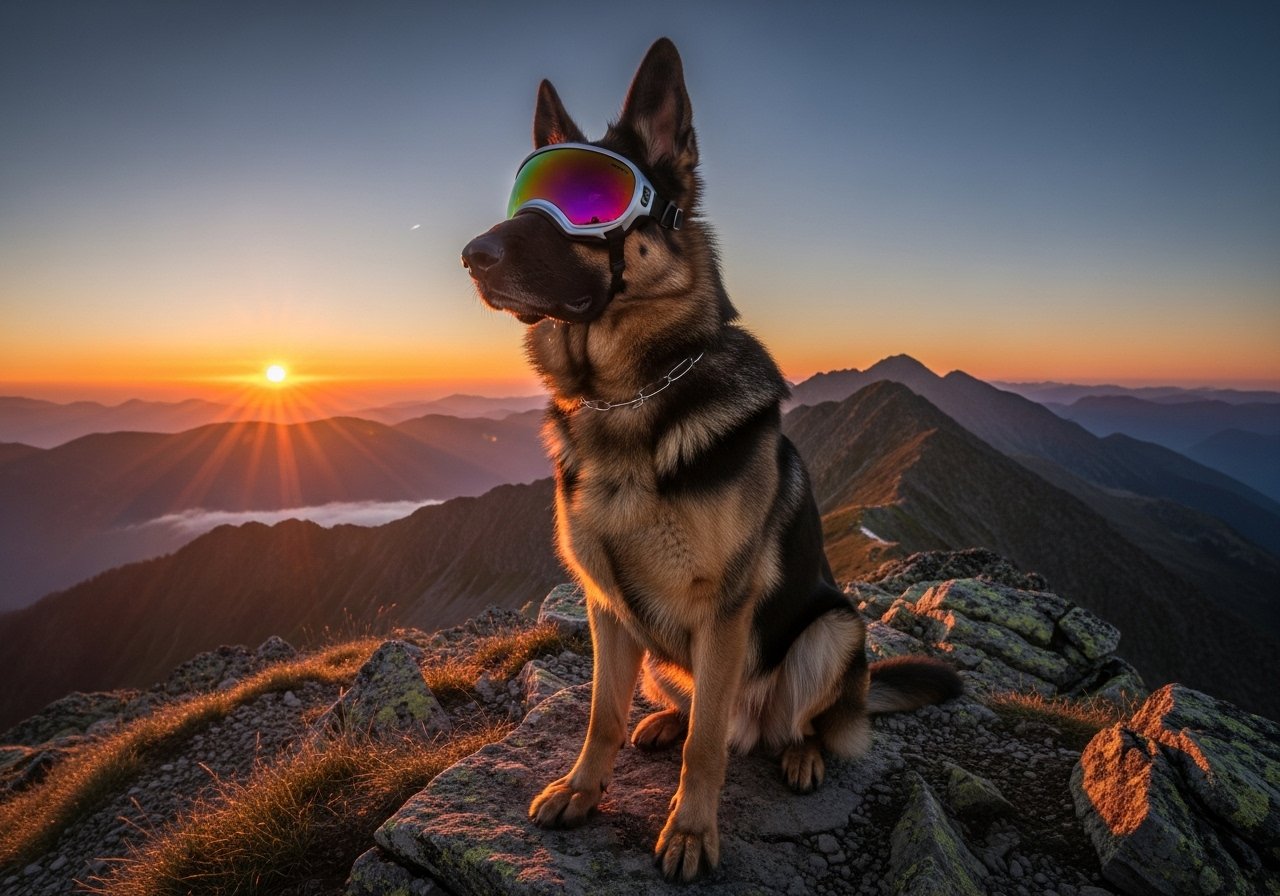
Protective eyewear for canines is often perceived as a novelty accessory, but for many dogs, it is a critical piece of equipment for their health and safety. Whether shielding sensitive eyes from harmful UV rays, protecting them from debris during outdoor adventures, or providing necessary post-operative care, goggles serve a vital function. However, asking a dog to accept something foreign on its face can be a significant challenge. Resistance is not a sign of defiance; it is a natural response to an unfamiliar sensation that can obstruct vision and feel restrictive.
This guide moves beyond mere coercion and into the realm of cooperative care. We will employ principles of classical and operant conditioning to systematically build a positive association with the goggles. The objective is not to force your dog to tolerate them, but to train them to see their eyewear as a precursor to positive experiences, such as an exciting car ride or a run on the beach. By following this professional protocol, you will build trust and communication, transforming a potential struggle into a successful training achievement.
Why Your Dog Resists Goggles: A Canine Perspective
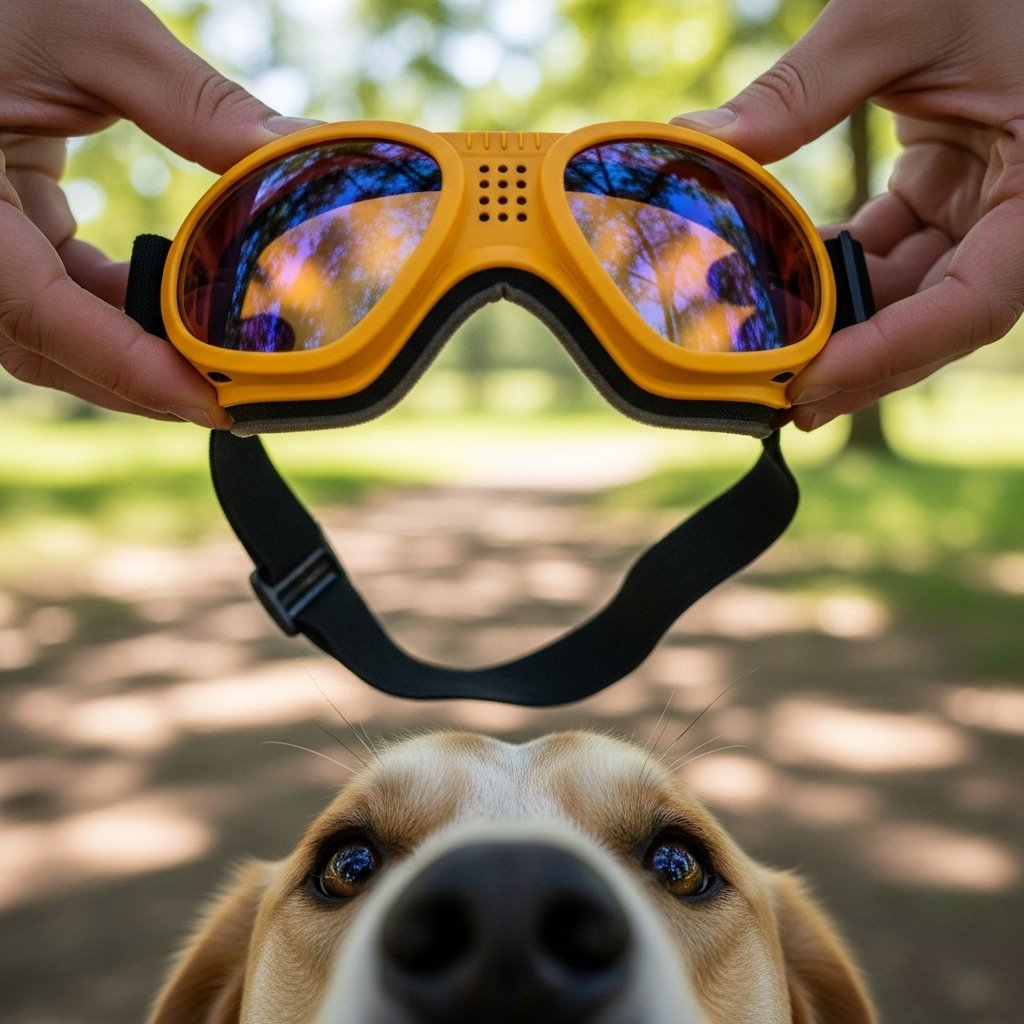
Before beginning the training process, it is crucial to understand the challenge from your dog’s point of view. A dog’s primary senses for interpreting the world are smell and hearing, but their vision is uniquely adapted for detecting motion. Goggles fundamentally alter their sensory experience in several ways. Firstly, they introduce pressure points on the sensitive areas of the face and head. Secondly, even the best-designed goggles will limit peripheral vision, which can be unsettling for a prey animal’s instincts. Finally, the goggles carry a foreign scent and feel unnatural against their fur.
When a dog paws at, shakes off, or runs from the goggles, they are communicating discomfort and anxiety, not stubbornness. Their reaction is a logical attempt to remove a confusing and uncomfortable object. Recognizing this allows us to approach training with empathy and patience, focusing on changing their emotional response from fear to anticipation. Our goal is to deconstruct the scary object into a series of non-threatening, rewarding steps.
The Foundation: Essential Tools and Mindset
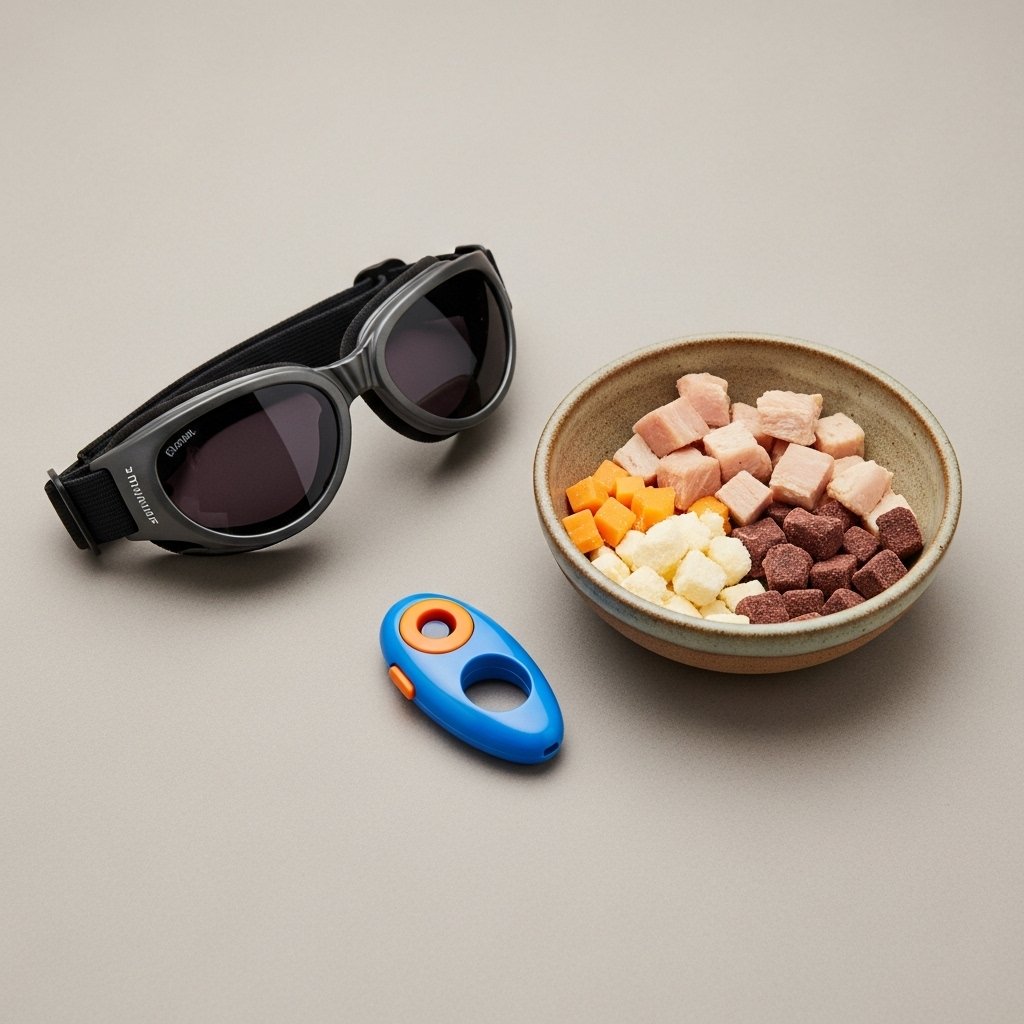
Success in this endeavor hinges on proper preparation. Rushing the process or using ill-fitting equipment will only create setbacks. Before you begin the first session, gather your tools and adopt the correct training mindset.
Choosing the Right Goggles
Not all dog goggles are created equal. Investing in a high-quality pair is essential for both comfort and safety. Look for the following features:
- Proper Fit: The goggles must be snug enough to stay in place but not so tight that they cause chafing or excessive pressure. They should have a deep enough lens cup so the lens does not press against your dog’s eyes. Many models are designed for specific head shapes.
- UV Protection: The lenses should offer 100% UV protection to be medically effective.
- Shatterproof Lenses: Polycarbonate lenses are the standard for durability and safety.
- Adequate Ventilation: Look for vents that prevent the lenses from fogging up, which can be disorienting for the dog.
- Adjustable Straps: Ensure both head and chin straps are fully adjustable for a secure, customized fit.
High-Value Reinforcements
Your dog’s regular kibble will not be motivating enough for this level of training. You need to use high-value treats—rewards that are exceptionally desirable. These should be small, soft, and easy to swallow quickly. Examples include tiny pieces of boiled chicken, freeze-dried liver, small cubes of cheese, or commercial soft training treats.
The Right Environment
Begin your training sessions in a quiet, familiar indoor space where your dog feels safe and there are minimal distractions. Keep sessions extremely short, especially at the beginning—one to three minutes at most. Your mantra should be to always end the session on a positive note, before your dog shows any signs of stress.
The Step-by-Step Training Protocol
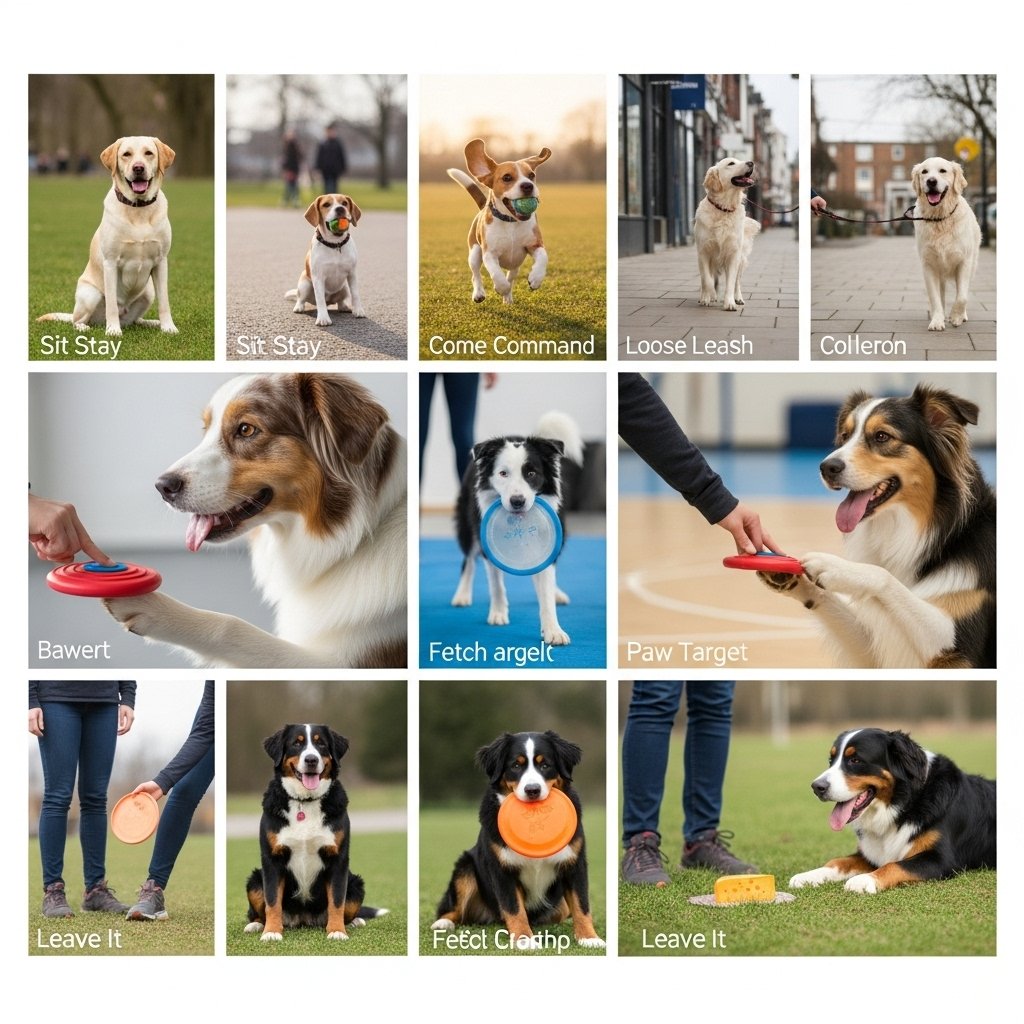
This process is a marathon, not a sprint. Each step must be mastered before moving to the next. If your dog shows stress at any point, simply go back to the previous successful step and work there for a few more sessions. The key is to make the goggles predict wonderful things.
-
Step 1: Introduction to the Object
Place the goggles on the floor. The moment your dog looks at them or sniffs them, mark the behavior with a verbal ‘Yes!’ or a clicker, and immediately give them a high-value treat. Do not try to put the goggles on. The goal is simply for your dog to see the goggles and think, ‘That object makes treats appear.’ Repeat this for several short sessions over a day or two.
-
Step 2: Creating a Positive Association
Hold the goggles in one hand and treats in the other. Hold the goggles up and, as your dog investigates, give them a treat from your other hand. Progress to holding a treat so that your dog has to put its nose through the frame of the goggles to get it. The goggles become a portal to rewards.
-
Step 3: Touching the Muzzle
Once your dog is eagerly putting its nose through the goggle frame, you can begin to briefly touch the frame to their face. For a fraction of a second, touch the part of the goggles that would rest on their muzzle to their muzzle. Mark and reward instantly. The touch should be so brief they barely register it before the reward comes.
-
Step 4: Brief Placement (No Straps)
With the straps dangling, briefly place the goggles onto your dog’s face in the correct position and remove them immediately. This should take less than a second. Mark and reward the moment the goggles are removed. You are rewarding their tolerance of the placement. Keep it light and fun, like a quick game.
-
Step 5: Introducing the Straps
Hold the goggles and let the straps dangle near your dog’s head and neck. Reward your dog for calmly accepting the presence of the straps. Gently touch a strap to the side of their head, then mark and reward. Drape the straps loosely over their neck, mark and reward, then remove. Break down every component of the process.
-
Step 6: Loosely Fastening
This is a critical step. Place the goggles on your dog’s face and loosely fasten the straps for a single second. Immediately unfasten, remove the goggles, and deliver a ‘jackpot’ reward—several treats in a row. The message is: ‘The straps closing predicts an amazing reward!’
-
Step 7: Building Duration
Once your dog is comfortable with the straps being fastened, you can begin to build duration. Fasten the goggles and feed a continuous stream of tiny treats while they are on. Start with just 2-3 seconds. The high rate of reinforcement keeps their mind on the treats, not the goggles. Slowly increase the duration over many sessions, from 3 seconds to 5, then to 10. If they paw at the goggles, the duration was too long. Go back to a shorter time.
-
Step 8: Generalization
When your dog can comfortably wear the goggles for 15-30 seconds inside, begin practicing in different rooms of the house. Then, move to a secure, low-distraction outdoor area like your backyard. The change in environment is a new variable, so you may need to decrease the duration initially.
-
Step 9: Adding Distraction and Movement
With the goggles on in the backyard, ask your dog for a simple, known cue like ‘sit’ or ‘touch’. Reward heavily. Take a few steps and have them walk with you. This teaches them they can still perform normal behaviors while wearing the equipment. Keep it fun and engaging.
-
Step 10: The Real World
Your first real-world application should be linked to an activity your dog absolutely loves. If they love car rides, put the goggles on just before getting in the car for a short, fun trip. If they love the beach, put them on for a brief part of the walk on the sand. The goggles now become the key that unlocks their favorite adventures.
Troubleshooting Common Issues
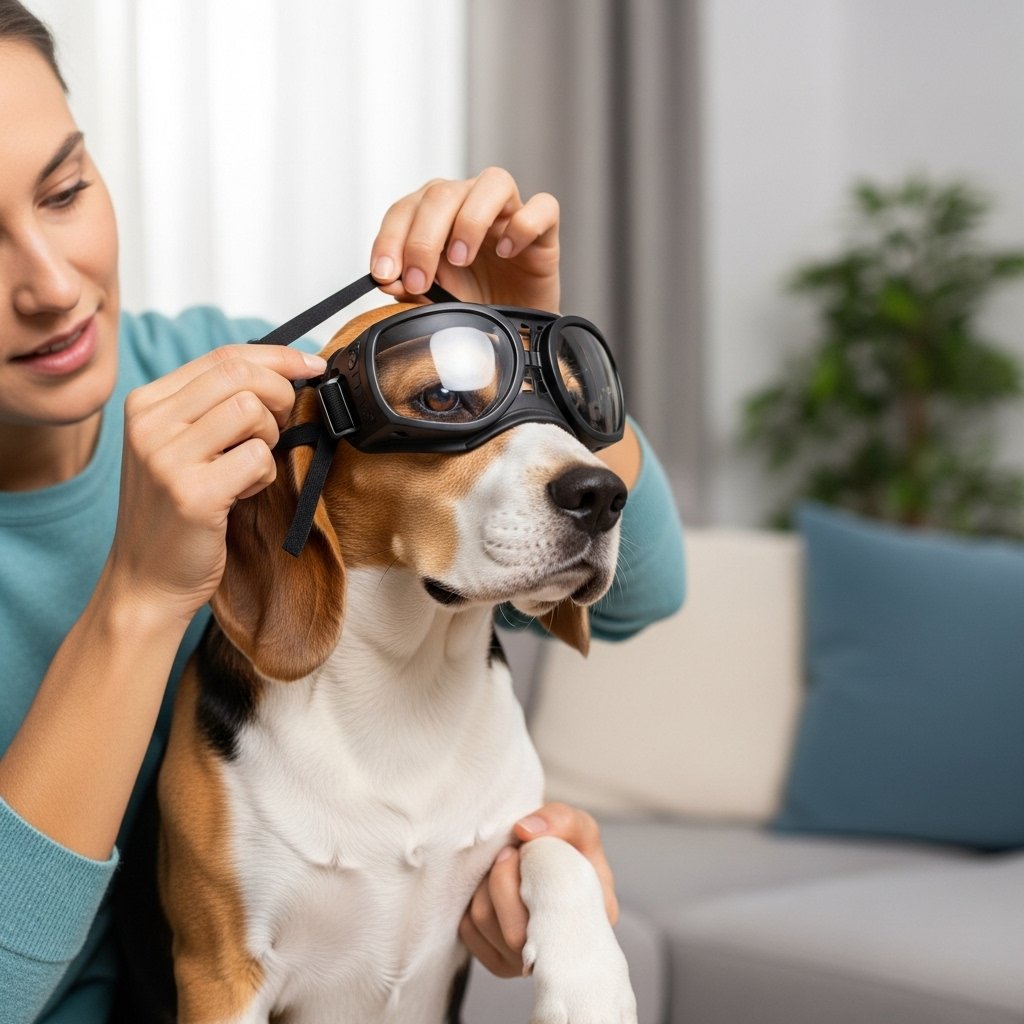
Even with a careful approach, you may encounter challenges. It is vital to interpret these behaviors as communication, not disobedience. Address the underlying cause rather than trying to suppress the behavior.
| Common Problem | Behaviorist’s Solution |
|---|---|
| Dog paws at the goggles immediately. | You have moved too fast or the duration is too long. Return to the previous successful step for several sessions. Ensure the fit is not pinching or pulling hair. The goal is for the dog to succeed. |
| Dog shakes their head excessively. | Check the fit, especially around the ears and under the chin. Hair may be caught in the straps. The goggles may also be too tight. If the fit is correct, reduce the duration they wear them and increase the value of the reward. |
| Dog becomes completely still or shows ‘whale eye’. | These are signs of significant stress, often called ‘shutdown’. Stop the session immediately. Do not try to push through. End on a positive note by asking for a simple cue they know well, like ‘sit’, and rewarding it. Give your dog a break for a day or two before attempting a much easier step. |
| Dog is fine inside but resists outdoors. | This is a generalization issue. The new environment adds too much stimulation. Practice in a quiet outdoor space like a backyard first, with very short durations and extremely high-value rewards, before venturing into more distracting public areas. |
Medical and Working Dog Applications
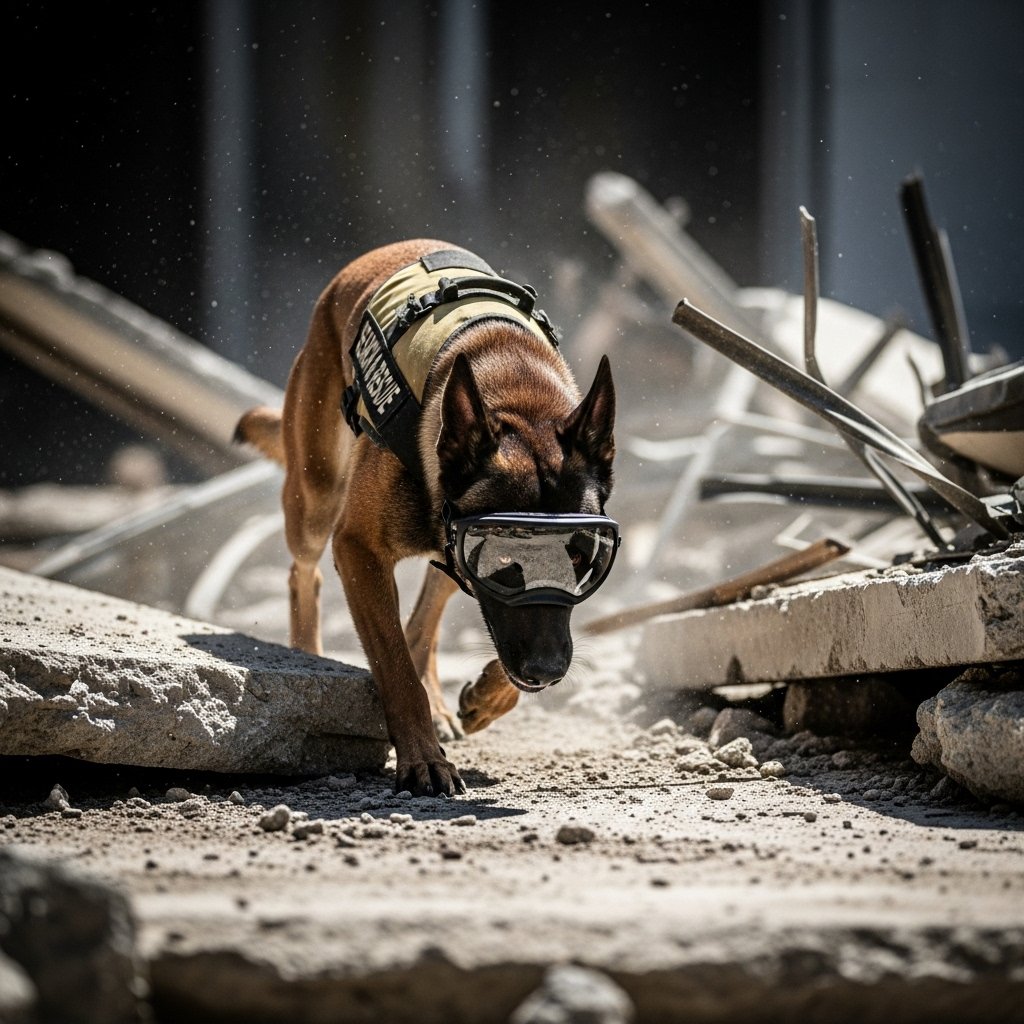
While training any dog to wear goggles is a valuable skill, for some it is a non-negotiable medical or professional necessity. Understanding these critical applications can provide powerful motivation to persevere through the training process.
Medical Conditions
Certain medical diagnoses require strict eye protection. Pannus (Chronic Superficial Keratitis), common in German Shepherds and Greyhounds, is an immune-mediated condition that is exacerbated by UV light exposure. Consistent use of UV-blocking goggles can slow the progression of the disease and preserve vision. Following any form of eye surgery, such as cataract removal or corneal ulcer repair, goggles are essential to prevent the dog from rubbing the eye and to protect it from dust and debris during the healing process.
Working and Adventure Dogs
For many dogs, goggles are part of their professional uniform. Military and Police K9s wear them for protection from dust, debris, and shrapnel during operations or helicopter deployments. Search and Rescue dogs navigating collapsed structures or dense wilderness rely on them to prevent eye injuries that could take them out of service. Beyond professional roles, dogs that participate in high-intensity activities—such as riding in motorcycle sidecars, boating in saltwater, or running on sandy beaches—benefit immensely from the protection against wind, water, and particulate matter.
Conclusion
Training your dog to wear goggles is a testament to the power of positive reinforcement and a strong human-animal bond. It is a process that requires patience, observation, and a commitment to your dog’s emotional well-being. By methodically building a foundation of trust and positive association, you can transform the goggles from an object of suspicion into a symbol of adventure and care. This skill not only opens up new possibilities for shared activities but also provides a crucial tool for safeguarding your dog’s precious eyesight for years to come. Remember to keep it positive, listen to your dog’s communication, and celebrate every small step of progress along the way.