
Fence Fighting? It Might Be Barrier Frustration (Not Aggression)

The scene is all too familiar for many dog owners: a peaceful afternoon in the yard is shattered by a sudden explosion of barking, lunging, and snarling along the fenceline. Your dog and the neighbor’s dog are engaged in what looks like a vicious fight, separated only by a thin barrier. This behavior, commonly called ‘fence fighting,’ is stressful for both the dogs and their owners. Many owners immediately assume their dog is aggressive, leading to worry and frustration. However, in a vast number of cases, this intense display is not rooted in a desire to harm, but in a complex behavioral response known as barrier frustration or barrier reactivity.
Understanding the distinction between true aggression and barrier frustration is the critical first step toward resolving the issue. Barrier frustration occurs when a dog is highly aroused by a stimulus (like another dog) but is prevented from physically reaching it by a barrier, such as a fence, a window, or even a leash. This thwarted desire to investigate, play, or engage converts into an outburst of frustrated energy. This article will serve as your authoritative guide to deconstructing this behavior, providing you with the knowledge to identify its root cause and the practical, humane training strategies to manage and modify it effectively.
Defining the Difference: Barrier Frustration vs. True Aggression
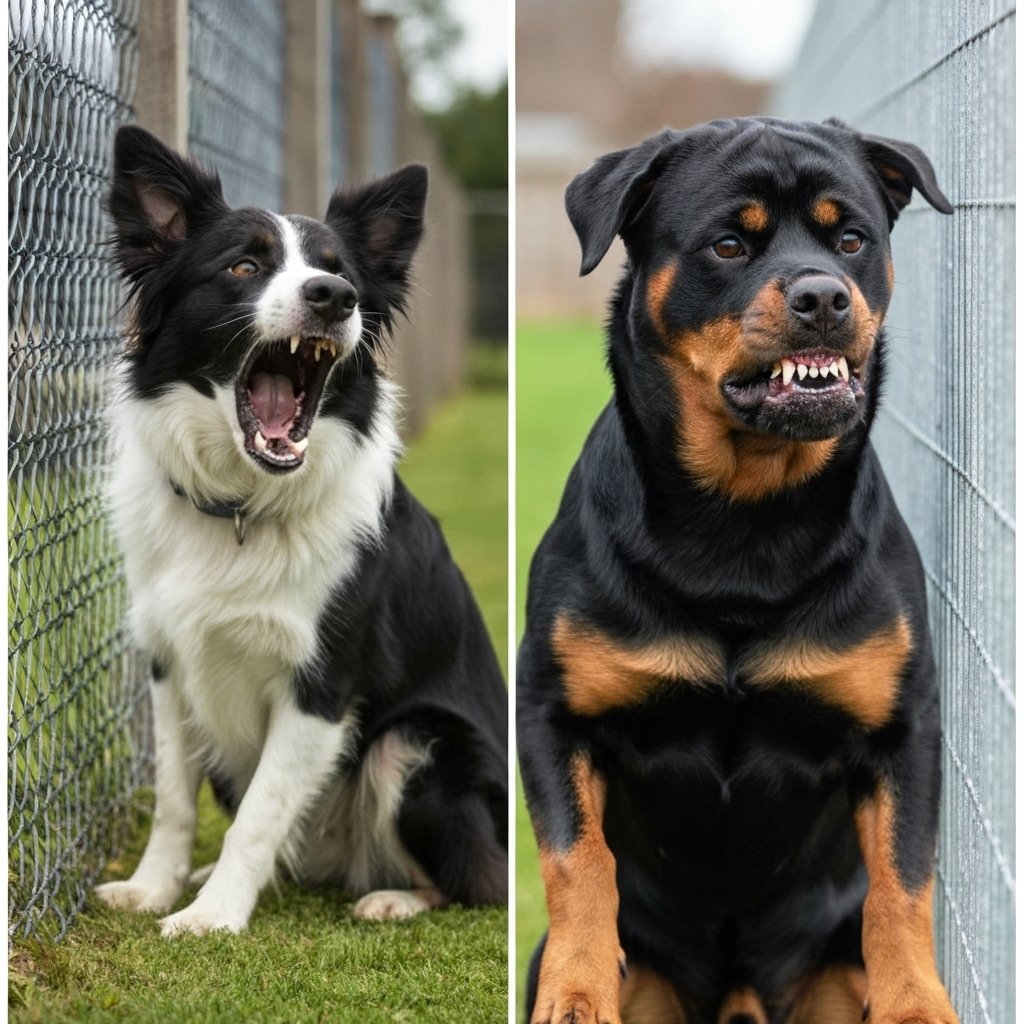
To effectively address fence fighting, one must first accurately diagnose the underlying motivation. While the outward signs can appear alarmingly similar, the emotional drivers behind barrier frustration and true aggression are fundamentally different. Misinterpreting the behavior can lead to ineffective or even counterproductive training methods.
Barrier frustration is a state of high arousal and stress caused by the inability to access a desired stimulus. The dog may want to greet, play with, or simply investigate the dog on the other side. When the fence prevents this, the dog’s excitement and energy have nowhere to go, erupting into behaviors like frantic barking, lunging, and pacing. Often, these same dogs are perfectly social and appropriate with other dogs when off-leash in a neutral environment. The barrier itself becomes part of the trigger, creating a conditioned response over time.
True aggression, on the other hand, is driven by an intent to cause harm. It is often rooted in fear, resource guarding, territorial defense, or pain. An aggressively motivated dog is not seeking to play or greet; it is trying to increase distance and eliminate a perceived threat. The body language is typically more offensive or defensively rigid, and the dog would likely engage in a physical altercation if the barrier were removed.
Expert Tip: A key diagnostic question to ask is, ‘How does my dog behave with other dogs when there is no barrier?’ If your dog has a history of positive, social interactions in parks or on playdates, the fence-line behavior is far more likely to be frustration-based.
| Behavioral Cue | Barrier Frustration | True Aggression |
|---|---|---|
| Vocalization | High-pitched, frantic, often continuous barking. May include whining or yelping. | Deep, guttural, menacing growling and barking, often in short, punctuated bursts. |
| Body Language | Loose, ‘bouncy’ body; rapid tail wagging (arousal, not happiness); play bows; spinning; pacing back and forth along the fence. | Stiff, rigid body posture; direct, hard stare; tail held high and stiff or tucked; piloerection (hackles raised); lip curling to show teeth. |
| Focus | Intense focus on the other dog, but may be interspersed with looks back at the owner or house. | Unwavering, fixated stare on the target. The dog is ‘locked on’ and difficult to distract. |
| Post-Encounter Behavior | May quickly return to normal behavior once the trigger is gone, though may remain aroused for a period. | Remains on high alert, scanning the environment for the threat long after it has passed. May be difficult to calm down. |
Management First: Creating a Less Reactive Environment

Before any effective training can begin, you must manage the environment to prevent the dog from practicing the unwanted behavior. Every time your dog engages in fence fighting, the behavior is reinforced and becomes more ingrained. Management is not a replacement for training, but it is a critical prerequisite for success.
Limiting Unsupervised Access
The simplest and most effective management tool is to stop leaving your dog unattended in the yard. If the triggers (neighbor’s dogs, passersby) appear unpredictably, your dog should only be in the yard when you are present to supervise and intervene. This prevents the cycle of rehearsal and reinforcement.
Modifying the Barrier
If the fence is see-through, such as a chain-link or wrought-iron fence, the constant visual stimulation is a primary cause of arousal. Consider these modifications:
- Privacy Screening: Install a commercial-grade privacy screen, which is an affordable and effective way to block the view.
- Fence Slats: For chain-link fences, privacy slats can be woven into the links to create a visual barrier.
- Landscaping: Planting a dense hedge or shrubs a few feet inside your fenceline can create a natural visual block and a buffer zone, preventing your dog from getting right up to the fence.
Managing the Neighbor’s Role
Open and polite communication with your neighbors can be immensely helpful. Explain that you are working on a training plan for your dog’s ‘barrier frustration.’ You might be able to coordinate yard times so your dogs are not out simultaneously, at least during the initial stages of training. This reduces the number of triggering events and sets your dog up for success.
Creating ‘Yard Enrichment’
Make the yard a place for calm, structured activities rather than a space for reactive behavior. When you are outside with your dog, engage them in activities that use their brain and encourage focus on you.
- Food Puzzles: Use puzzle toys or snuffle mats in the yard.
- Training Sessions: Practice basic obedience cues like ‘sit,’ ‘stay,’ and ‘come.’
- Structured Fetch: Play fetch with clear rules (e.g., dog must sit before you throw).
By implementing these management strategies, you lower your dog’s overall stress levels and stop the reinforcement of the fence-fighting behavior, creating the calm state of mind necessary for effective training to take place.
A Step-by-Step Training Protocol to Resolve Barrier Frustration
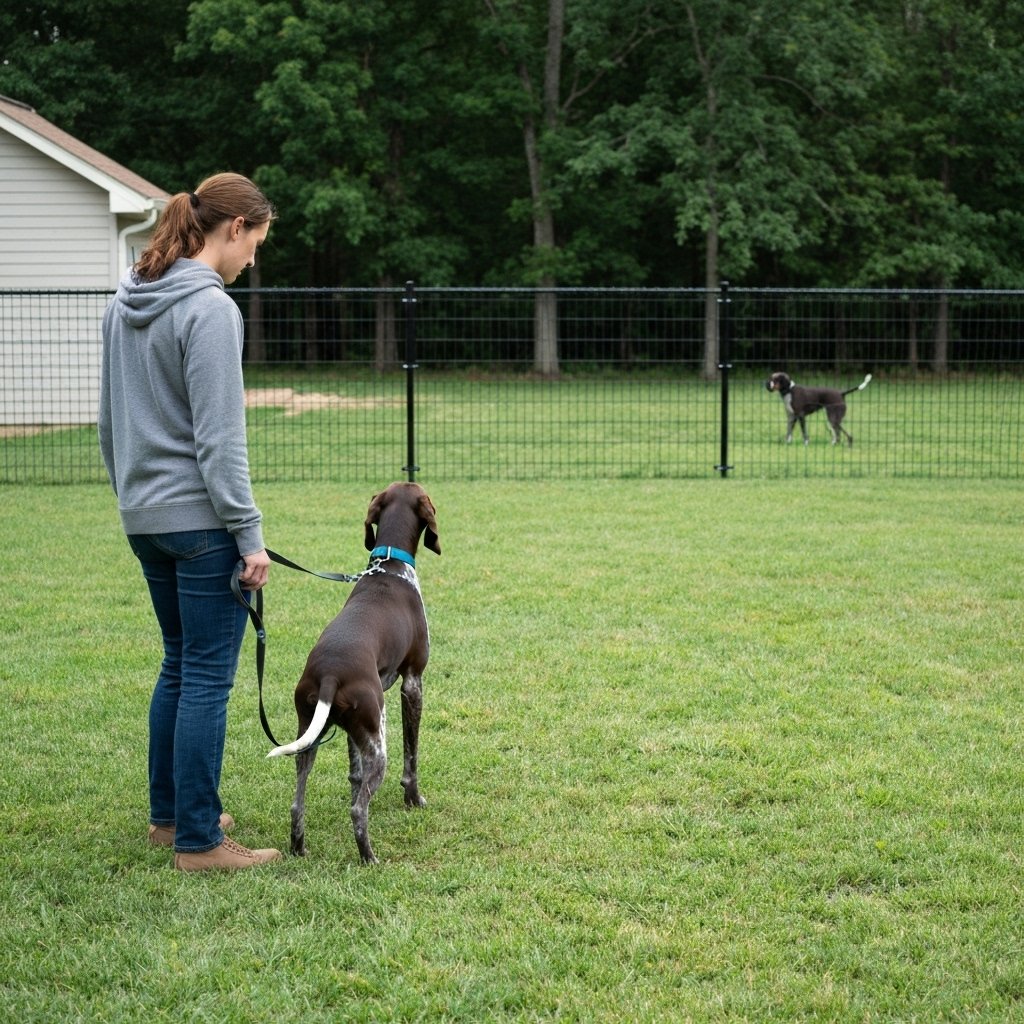
With management strategies in place, you can begin the process of actively changing your dog’s emotional response to the presence of another dog behind the fence. The goal is to use desensitization and counter-conditioning (DSCC) to teach your dog that the other dog’s presence predicts good things (like high-value treats) and that remaining calm is more rewarding than reacting.
What You’ll Need:
- High-Value Treats: Small, soft, and extra-special treats that your dog loves, such as boiled chicken, cheese, or commercial training treats.
- A Leash or Long Line: To maintain control and prevent your dog from rushing the fence.
- A Cooperative Assistant: A friend or neighbor with a calm dog who can help with controlled setups.
Step 1: Foundational Skills Away from the Fence
Before working near the fence, ensure your dog has a solid foundation in a few key skills in a low-distraction environment, like your living room.
- Name Recognition: Your dog should reliably orient toward you when you say their name.
- ‘Look at That’ (LAT): This game teaches your dog to look at a trigger and then immediately look back at you for a reward. Start with neutral objects and gradually work up to more exciting things.
- Emergency Recall: A rock-solid ‘come’ command that works even when distracted.
Step 2: Controlled Setups Below Threshold
Your dog’s ‘threshold’ is the distance at which they can notice a trigger without reacting. The goal is to work below this threshold. Start with your dog on a leash at a far distance from the fenceline inside your yard where they can barely see the trigger dog (your assistant’s dog) on the other side. The moment your dog notices the other dog, mark the behavior with a ‘Yes!’ or a clicker and reward them. If your dog fixates, barks, or lunges, you are too close. Increase the distance and try again.
Step 3: Gradually Decreasing Distance
Over multiple sessions, as your dog remains calm and looks to you for a treat after seeing the other dog, you can slowly decrease the distance to the fence by a few feet at a time. This process must be gradual. A single reactive outburst can set your training back significantly. Keep sessions short (5-10 minutes) and always end on a positive note. The goal is to change the underlying emotion from ‘Oh no, that dog!’ to ‘Oh good, that dog means I get chicken!’.
Step 4: Real-World Application and Emergency Maneuvers
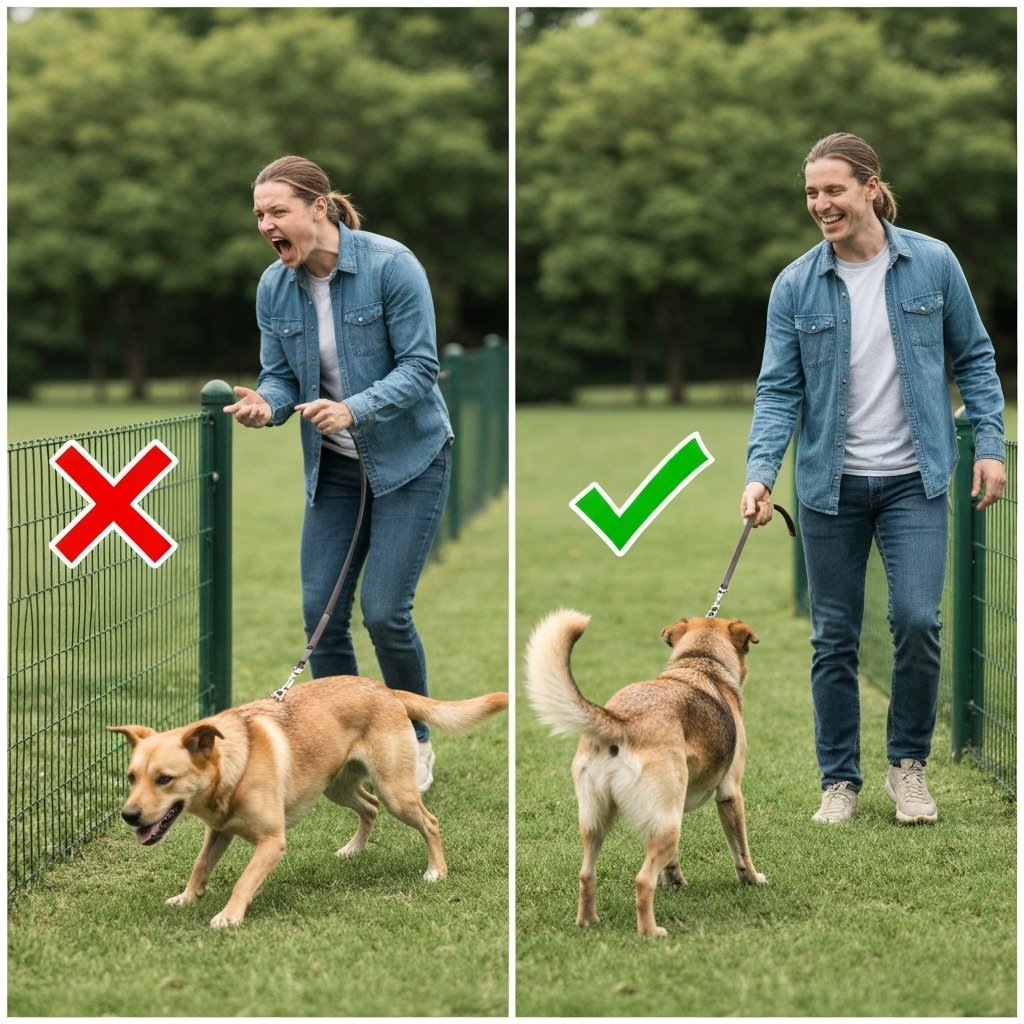
Once your dog can remain calm at a closer distance during controlled setups, you can start applying the skill in more realistic scenarios. Keep your dog on a long line for safety. If an unexpected dog appears and your dog begins to react, do not panic or punish. Instead, use your ‘Emergency U-Turn’ maneuver: cheerfully say ‘This way!’ and move quickly in the opposite direction, encouraging your dog to follow. Once you’ve created distance and your dog is calm, reward them. This teaches them a constructive way to disengage from a stressful situation.
Common Mistakes Pet Owners Make and How to Avoid Them
The path to resolving barrier frustration is paved with patience and consistency, but several common mistakes can derail progress. Being aware of these pitfalls can help you stay on track and ensure your training is both humane and effective.
Mistake 1: Punishing the Reaction
It’s a natural human response to want to stop the loud, embarrassing display of fence fighting. Many owners resort to yelling ‘No!’, yanking on the leash, or using aversive tools like shock collars or spray bottles. This is a critical error. Punishment-based methods do not address the underlying emotion of frustration or arousal. Instead, they often increase the dog’s anxiety and stress, creating a negative association with the trigger. The dog learns that the presence of another dog predicts not only frustration but also punishment from their owner, which can escalate the behavior or lead to other, more severe issues.
Avoid it by: Focusing exclusively on management and positive reinforcement. If your dog reacts, your primary goal is to create distance and help them calm down, not to punish the outburst.
Mistake 2: Moving Too Fast in Training
Enthusiasm is great, but impatience is the enemy of effective behavior modification. Owners often see a little bit of progress and immediately try to rush to the finish line, working too close to the fence or the trigger dog before their own dog is emotionally ready. This almost always results in the dog going over threshold and having a reaction, which undoes previous learning and can make the dog more hesitant in future sessions.
Avoid it by: Being a meticulous observer of your dog’s body language. Learn to recognize the subtle signs of stress (lip licking, yawning, stiffening) that occur before the barking starts. Always work at a distance where your dog is successful, and only decrease the distance in very small increments.
Mistake 3: Inconsistent Management
You can have the best training plan in the world, but if you only follow your management protocol some of the time, you will see little progress. Letting your dog out unsupervised ‘just for a minute’ can be all it takes for an incident to occur, reinforcing the fence-fighting behavior and undermining your training efforts. Consistency is paramount.
Avoid it by: Committing 100% to your management plan with all members of the household. The rule should be simple: the dog is never in the yard unattended until the training has progressed to a point of reliability. Treat management as the foundation upon which all training is built.
Conclusion
Addressing fence fighting and barrier frustration is a journey that requires empathy, patience, and a commitment to understanding your dog’s emotional state. By shifting your perspective from viewing the behavior as ‘aggression’ to recognizing it as ‘frustration,’ you unlock a more compassionate and effective path forward. The solution lies not in punishment or quick fixes, but in a dual approach of diligent environmental management and a systematic, positive reinforcement-based training plan.
Remember to celebrate the small victories, whether it’s your dog noticing another dog without reacting or disengaging from the fence to check in with you. These moments are the building blocks of new, healthier behavioral patterns. While the process can feel slow, consistency is your greatest asset. By managing the environment to prevent the behavior and actively teaching your dog a better way to cope with their big feelings, you can transform your yard from a stage for stress into a sanctuary of peace for both you and your canine companion. If you feel overwhelmed or are not seeing progress, do not hesitate to consult a certified professional dog trainer or veterinary behaviorist for personalized guidance.