
Why Does My Dog Howl When I Sing? It’s Not Because You’re Bad!

It’s a scene familiar to many pet owners: you’re in the car, in the shower, or just cleaning the house, and you decide to belt out your favorite tune. Before you can even get to the chorus, you have a duet partner. Your dog, with head tilted back and a mournful, soulful sound, has joined in. The immediate human reaction is often self-conscious laughter, followed by a nagging question: Is my singing really that bad?
Rest assured, your canine companion is not providing a critique of your vocal performance. A dog howling when you sing is a complex, fascinating behavior with roots deep in their ancestral past and their unique physiology. It’s a form of communication, a reaction to specific sounds, and often, a display of bonding. This article will serve as a comprehensive guide for pet owners, delving into the scientific and instinctual reasons behind this common behavior. We will explore the echoes of their wolf lineage, the intricacies of the canine auditory system, and how to interpret what your dog is truly trying to tell you. By the end, you won’t just understand why your dog sings along; you’ll have a deeper appreciation for the incredible ways they communicate with us.
The Ancestral Echo: Howling as a Pack Instinct

To truly understand why your dog vocalizes when you sing, we must first look back thousands of years to their ancestor, the wolf. For wolves, howling is not a random act; it is a vital and sophisticated form of social communication. It serves several critical functions within the pack structure, and these ancient instincts are still very much alive in our domestic dogs.
Social Bonding and Assembly
The primary function of a group howl is to reinforce social bonds and rally the pack. It’s an auditory roll call, allowing pack members to locate one another over vast distances, declare their territory to rival packs, and strengthen their sense of unity. When one wolf starts, others join in, creating a chorus that solidifies their identity as a cohesive group. When you sing, especially at a high pitch or with sustained notes, you may be inadvertently mimicking this call to the pack. Your dog, hearing this ‘group vocalization,’ isn’t judging you; they are participating. In their mind, you have initiated a group activity, and they are enthusiastically joining in to strengthen your two-member pack.
Triggering an Instinctive Response
Certain sounds are known to trigger howling in dogs, including sirens, musical instruments, and, of course, human singing. These sounds often share acoustic characteristics with a natural howl—they are high-pitched and sustained. This acts as an innate releasing mechanism, a specific stimulus that triggers a fixed action pattern. The dog isn’t necessarily making a conscious decision to howl but is instead reacting to an ancient, hardwired instinct. It’s a powerful echo of their heritage, a behavior so deeply ingrained that a simple melody can bring it to the surface.
Expert Tip: Observe when your dog howls. Do they do it for specific songs or pitches? Recognizing the triggers can help you understand that the response is more about the sound’s quality than its content or your vocal talent.
The Science of Sound: A Canine Auditory Perspective
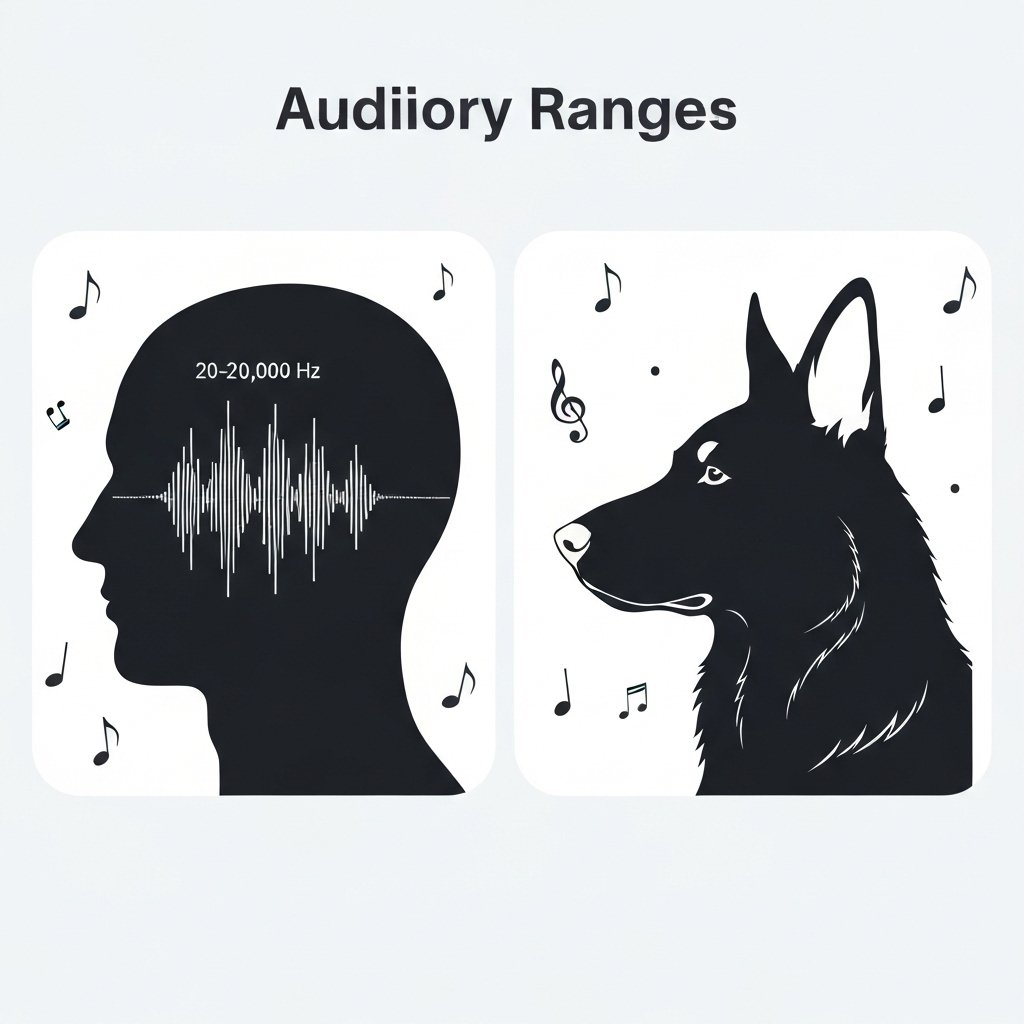
While instinct plays a massive role, canine physiology is an equally important piece of the puzzle. Dogs experience the world of sound in a fundamentally different way than humans do, and their unique auditory capabilities can explain why your singing voice elicits such a strong vocal reaction.
A Wider Range of Hearing
The most significant difference is the range of frequencies dogs can detect. Humans typically hear sounds in the range of 20 to 20,000 Hertz (Hz). Dogs, on the other hand, can hear sounds up to 45,000-65,000 Hz, well into the ultrasonic range. Your singing voice, while seemingly normal to you, contains overtones and harmonics that extend into these higher frequencies. It’s possible that these high-frequency sounds, which you can’t even perceive, are what trigger your dog’s howling response. To them, these frequencies might sound remarkably similar to the pitch of another dog’s howl, prompting them to answer in kind.
Is the Sound Painful?
A common concern for owners is that their singing might be physically hurting their dog’s sensitive ears. In most cases, this is highly unlikely. Painful sounds typically induce a different reaction—whimpering, cowering, hiding, or trying to escape the room. A dog that is howling along is generally engaging with the sound, not retreating from it. However, certain pitches could be irritating or strange to them, prompting a howl as a way to ‘talk back’ to the unusual noise or attempt to modulate it with their own voice. Think of it less as pain and more as a reaction to a bizarre and compelling auditory sensation they feel the need to interact with.
Decoding the Duet: What Your Dog Might Be Communicating

Since your dog can’t tell you in words why they’re howling, it’s up to us to interpret their behavior. The howl is a form of communication, but the specific message can vary depending on the context and the individual dog. By observing the circumstances and their accompanying body language, you can get a better idea of what they are trying to say.
Possible messages behind the howl include:
- Participation and Joy: This is the most common and positive interpretation. The dog perceives singing as a joyful, communal activity and wants to be part of the fun. Their howl is the equivalent of a human singing along to a favorite song at a concert.
- A Bid for Attention: You are engrossed in an activity that doesn’t involve them. Singing requires focus, and your dog may notice that your attention has shifted entirely. The howling can be a very effective strategy to redirect your focus back to them. ‘Hey, what about me?’
- Alerting the ‘Pack’: Some dogs may misinterpret the unusual sounds of human singing as a potential alert. They may be howling to signal to you, their pack leader, that they have noticed a strange sound that warrants attention, unaware that you are the source.
- Excitement or Arousal: The energy and emotion you put into singing can be contagious. Your dog may pick up on your heightened emotional state and express their own resulting excitement or arousal through vocalization.
Understanding the motivation is key. If the howling is accompanied by a wagging tail and relaxed posture, it’s likely a happy expression. If it’s paired with pacing or anxious behaviors, it might be a bid for attention or a sign of mild stress.
Is It Enjoyment or Distress? Reading Canine Body Language

This is the most critical skill for any pet owner: distinguishing between a dog who is happily participating and one who is experiencing stress or anxiety. A howl is just one piece of data; the rest of your dog’s body tells the full story. Paying close attention to these cues ensures the well-being of your pet and helps you respond appropriately.
Use this table to compare the signs of a happy ‘sing-along’ with the signs of auditory-induced stress.
| Body Language Cue | Signs of Enjoyment / Participation | Signs of Stress / Anxiety |
|---|---|---|
| Tail | Loose, relaxed, wagging in a wide, sweeping motion or held in a neutral position. | Tucked between the legs, held low and rigid, or wagging stiffly and rapidly (a ‘helicopter tail’). |
| Ears | Held in a natural, relaxed position or perked forward with curiosity. | Pinned back flat against the head. |
| Mouth | Relaxed, possibly open in a ‘smile.’ The howl itself is the main vocalization. | Lips pulled back, excessive panting, lip licking, or yawning when not tired. |
| Body Posture | Loose, wiggly, may offer play bows or lean into you affectionately. | Stiff, tense, cowering, or hunched over. May pace or seem unable to settle. |
| Overall Behavior | Seeks proximity to you, makes eye contact, seems engaged and happy. | Tries to leave the room, hides behind furniture, avoids eye contact. |
If your dog displays any signs from the ‘Stress / Anxiety’ column, it’s best to stop singing and comfort them. It may indicate that the specific pitch or volume is genuinely uncomfortable for them, and the interaction should not be forced.
Managing the Music: How to Respond to Your Howling Dog

Once you’ve determined the likely reason for your dog’s howling and confirmed they are not in distress, you can decide how to proceed. Your response will depend on whether you find the behavior endearing or disruptive. There are effective, positive ways to manage the behavior in either scenario.
How to Discourage the Howling
If the howling is too loud, disruptive to neighbors, or you simply prefer a quieter environment, you can train your dog to offer an alternative behavior. The key is to never punish the howling, as it’s a natural instinct. Instead, use positive reinforcement.
- Redirection: As soon as you start to sing and before the howl begins, redirect your dog’s attention to a high-value chew toy or a food puzzle. This gives them a quiet, enjoyable activity to focus on instead.
- Reinforce Quiet: Practice singing a few notes. If your dog remains quiet, immediately praise them and offer a treat. Keep these training sessions short and positive. You are teaching them that silence during singing is a highly rewarded behavior.
- Change the Environment: If the howling persists, you can manage the situation by putting your dog in another room with a favorite toy before you start your singing session.
How to Encourage It as a Bonding Activity
Many owners cherish these musical moments with their pets. If your dog is clearly enjoying themselves, you can embrace it as a unique bonding experience.
- Cue the ‘Sing’ Command: Turn the instinctual behavior into a fun trick. Start singing and when your dog howls, say a cue word like ‘Sing!’ and reward them enthusiastically. Over time, they will associate the word with the action.
- Keep it Positive: Always keep these sessions upbeat and fun. If the dog stops, don’t force them to continue. Let it be their choice to participate.
- Record Your Duets: Capture these special moments! It’s a wonderful and unique part of your relationship with your dog that you’ll enjoy looking back on.
Conclusion
The next time your dog joins you in song, you can smile with a newfound understanding. That howl is not a harsh critique of your vocal skills but a beautiful, complex expression of instinct, communication, and connection. It’s a link to their wild ancestry, a reaction to the unique physics of sound, and above all, a testament to the bond you share. Whether you choose to nurture your private duet or train for a quieter performance, you are now equipped to interpret their message. By listening not just with your ears, but with an understanding of their behavior and body language, you can respond in a way that respects their nature and deepens the incredible relationship you have with your canine companion. So go ahead, sing your heart out—and enjoy the response from your number one fan.